Read This Book!!

Since the days of former president Paul LeClerc, the trustees of the New York Public Library have done everything in their robber baron powers to sell off or compromise the value of the institution as a research library open to those who would use it for serious purposes. At one point the current NYPL president Anthony Marx said that their aim was to make the institution more democratic, but unlike other high caliber research libraries, it was already a temple of democracy open to anyone from anywhere who wished to read, to research, to learn, to create. Two examples are a housewife and writer who used its collections to turn out The Feminine Mystique, and a journalist who produced The Power Broker, an exposé of development run amok. Maybe those are the kinds of users and truth-bearers the trustees decided to squash or hamper in favor of encouraging noisy tourists who disrupt those using the library’s materials.

Trustees also used the library’s finances as a rationale, but they undercut their own argument when they hatched, in off-the-record sessions, a plan to pay British starchitect Sir Norman Foster $9 million for a design scheme that would have gutted the structure of the building, including the steel stacks holding books. Sir Norman’s plan did result in its research collection being off-loaded to a storage facility in New Jersey. Fortunately that plan failed, although the off-loaded materials have yet to be returned and bare stacks abound in public rooms. It is surely not an accident that the most influential trustees of the NYPL are real estate tycoons and financiers. They drove the sale and destruction of the much-used East 50s branch, the Donnell Library, at a fire sale price of $59 million. After the branch was demolished, a penthouse in the tower being constructed on the site sold for $60 million. How clueless can these trustees really be and who are they serving?

In much-more measured prose than demonstrated in the above paragraphs, Scott Sherman uncovered this story for The Nation. His spare and elegant book Patience and Fortitude Power Real Estate and the Fight to Save A Public Library would be the rewarding experience of an evening’s reading if one could concentrate on the fact that the Foster/Central Library Plan was quashed when Mayor Bill de Blasio declined to fund it. However, the trustees involved are still active. Equally important, the book is revelatory of the capture of the boards of nearly every civic organization in the city by financial and real estate profiteers who know only cronyism and financial gain and are capable of nothing else. Happily, Sherman portrays many interesting and constructive New Yorkers in Patience and Fortitude. These labor tirelessly in the light for public good and not in closed session. One pivotal player in the defeat of the Central Library plan was a young member of the state assembly named Micah Kellner who chaired the Assembly’s library committee and was also running for New York City Council. In late June, 2013 he held an 8-hour public hearing that inspired a closer look at the plan. It galvanized and unified its opponents and led to lawsuits by distinguished scholars. A month after the hearing, Kellner’s career was effectively destroyed. The N.Y. Times reported that four years earlier a junior staff member had charged Kellner with verbal sexual harassment. Assembly Leader Sheldon Silver (his own troubles surfacing) claimed that he had only just learned of the 2009 episode and a similar alleged incident that had occurred in 2011. Kellner, who is openly bi-sexual as well as a husband and father, lost his bid for the City Council. Sexual harassment, especially if it is actually proven, is indefensible, but the timing of the career-killing charges is interesting. Power is not power unless it is exercised. But perhaps there are Higher Powers. A few weeks after the Central Library Plan was abandoned in May 2014, a section of the Rose Reading Room ceiling collapsed. Normal wear to the steel trusses that supported it was blamed. Repairs continue and the huge expanse is still shuttered. But what greater, un-doable damage might have been done if the trustees had been allowed to rip out the steel trusses altogether? How many oligarch-ready condos might have been built like the ones that are going up where the popular, democratic Donnell Library once stood? It’s too late for patience. Now urgency and fortitude are called for, along with Distrust of trustees. What do you think? Please comment in the box below.

Learning to Step On Tolerant Toes

At last New Yorkers have reason to be happy that the Metropolitan Transit Authority’s courtesy campaign has been a total failure. It’s a sign that riders don’t pay attention to notices on subways and busses! This makes me feel better about the U.S. District Court judge who would allow the pro-Israel American Freedom Defense Initiative to run an ad featuring a menacing Arab and the words “Killing Jews is Worship that draws us close to Allah.” [See AFDI photo featuring a non-menacing American] The ad attributes this to Hamas TV and adds this line below the quote: “That’s his Jihad. What’s yours?”

The AFDI wanted to run this message in the NYC transit system last year, but the MTA rejected it saying it could be a call to violence again Jews. The AFDI sued and won Tuesday in the U.S. District Court. Today the MTA tried to blunt the ruling by sending a letter to the judge saying that at its April 29 meeting the MTA board will establish a new policy to ban ads of a political nature. The MTA also has 30 days to appeal the decision through the courts.

Judge John G. Koeltl of the U.S. District Court sided with the AFDI based in part on the lack of evidence that similar ads in Chicago and San Francisco had ill effect. He also noted, “The defendants underestimate the tolerant quality of New Yorkers and overestimate the political impact of these fleeting advertisements.”

Who Say's it's A Sharing Economy?

Pole Hog Under “Don’t Be A Pole Hog” message

Well, okay. We could also call New Yorkers “tolerant” rather than “dangerously self-absorbed” when they ignore the following notices that are part of the MTA courtesy campaign: “Step Aside to Let Others Off First.” “Don’t Be a Poll Hog.” “Keep the Doors Clear So Others Can Board.” Riders of all races, colors, creeds and nationalities feel free to block subway doors and restrict entry to other riders whether a car is empty or has relative extra room at rush hour. We could be helping each other, but we don’t.

This behavior comes at a time when ridership is the greatest it has been in 65 years and crowding is a serious problem. I would like to believe that it is tourists who are behaving in such piggish ways, but they seem to find bad behavior part of the show. In any event, if the AFDI does get to run its ad, tourists will have more to see. Not so New Yorkers who will be too tolerant to take much notice, according to the judge. Would they clear the doorway if a police officer asked them to? Would it be helpful to find out? Please scroll down to the “Leave a reply” box and comment.

Update: On Monday April 27 the MTA board voted 7 to 2 in favor of banning political and other controversial ads. A WSJ story notes that government agencies that restrict ad to commercial content generally prevail when challenged in the court. Hooray (for once) for the MTA!

Subway Art Made and Found

Riders of New York City subway are likely to have their eyes glued to mobile devices these days, but those who look around, especially when they transfer, often see mosaics, sculpture and stained glass by established and emerging artists. This is well documented in a new book New York’s Underground Art Museum that features one hundred images displayed throughout the boroughs.

The Times Square station presents two distinguished murals — a glass mosaic by Jacob Lawrence and one nearby in porcelain enamel by Roy Lichtenstein.

Lichtenstein Mural, Times Square subway station

Photo by Rob Wilson for the MTA

But beauty with a nod to abstract expressionism, occurs as commercial images wear away. Please scroll down to the “Leave a reply” box and comment.

Photos by Kathleen Brady

Photos by Kathleen Brady

DSCN2435
DSCN1708

Who are Patrick Lynch’s Real New Yorkers?

As president of the Patrolmen’s Benevolent Association, Patrick J. Lynch may be obligated to stand up for every union member who commits a questionable act, even an indefensible one. However, his actions and tone are those of thug, of someone more like a semi-literate television Mafia capo rather than a responsible police officer. Lynch has created, or highlighted, a fissure that exists between an insubordinate, armed police force and the people of New York City, a large number of whom took to the streets in December to protest police treatment of minorities. Why has the media styled growing questions about a pattern of police conduct as an issue between Lynch’s rank and file and the mayor? Possibly because Lynch has spun it that way. Mayor Bill de Blasio owes “New York’s Finest” no apology for voicing concern about dubious actions by some officers – one of whom used a banned chokehold that killed Eric Garner and another who opened the door to a public housing stairwell with the use of a loaded and drawn gun, thereby killing Akai Gurley. The mayor owes no apology for drawing a distinction between officers who serve the public trust and those whose actions invite scrutiny. In every his pronouncement de Blasio has indicated that he does “have the back” of a responsible police force, despite the disrespect of those who literally have turned their backs on him at recent public events, including funerals of assassinated officers. Nonetheless, some contrition is due: Lynch owes an apology to New Yorkers for a work slowdown that has cost the city as much as $10 million per week, according to the Citizen’s Budget Commission, which bases the figure on a drop in the issuance of parking tickets. The N.Y. Daily News reports that Lynch has told his members to go back to doing half of their former workload.  Meanwhile, with all this going on, Lynch through the PBA website and in newspaper ads thanks “real New Yorkers” for not believing that their insubordination has anything to do with labor negotiations and for “holding accountable” those who stir up hatred and violence against police officers.  The question is what kind of people does Lynch regard as “real New Yorkers” because sadly, almost half of his members, notably the white ones, don’t qualify. Some 40 percent are suburban and exurbanites, according to data from the U.S. Equal Employment Opportunity Commission and the Census Bureau. That is a smaller percentage than those other large U.S. cities, but the numbers provoke even more thought when they are examined along racial lines. While 77 percent of black officers live in the five boroughs and 76 percent of Hispanic ones do, only 45 percent of white officers are “real New Yorkers,” if being a “real New Yorker” means residing here and paying city taxes. Minority police officers are more likely than their white colleagues to be willing to live among the people they serve and, apparently, be comfortable with us and raise their families alongside ours. When it comes to living here, can we say that New York City police officers are turning their backs? If minority cops can find a way to afford living here, why can’t – or won’t — white ones? Could moving out of the boroughs be the most questionable act of all? Please scroll down to the “Leave a reply” box and comment.

Looking for Hope, Even If It Kills Us

Four encouraging things have come out of the unrest resulting from a Staten Island grand jury’s failure to indict the policeman who killed Eric Garner. Garner, who was apparently selling illegal loose cigarettes, was subdued with a banned chokehold after he was surrounded by three policemen, each of whom was almost as big as he was. The grand jury’s decision deprived prosecutors of the opportunity to present facts in court, including those that might have explained the policeman’s action. Nonetheless, here are the emerging good things, one for each week in this season of Advent:

  1. For those who doubt that black and white men are not treated equally under the law, Jim Dwyer, columnist for the N.Y. Times, provided clear if appalling evidence when he detailed the wildly different ways that police dealt with two graduate students at the Union Theological Seminary after they were arrested for blocking traffic.

  2. White people in meaningful numbers are marching with the black community to demand respect for black lives, including those individuals who are suspected of criminal behavior. On the night protests began, I encountered a rolling protest on West 47th Street. Seeing that nearly all the protesters in front of me were white, I burst into tears. It took a few days for me to understand why since the full range of ethnicities I knew was appalled about the lack of indictments in Ferguson, Missouri and certainly about what seems to be a clearer case in Staten Island. Turns out, I was touched by the sight of a huge diverse group of people finally making demands to show that we are one society and that injustice to one group (be it physical or economic) is an attack on everyone.

  3. While some three hundred demonstrators have been arrested, the NYC police have been more focused on maintaining order than in threatening and punishing protestors. At a breakfast of business leaders a few weeks ago, Police Chief Bill Bratton acknowledged that the approach was “hands off” in part to save police time and to avoid paying compensation for over-reacting, as occurred during the Bloomberg Administration. He explained that the city is paying out some $18 million in claims from the 2004 Republican National Convention and the Occupy Wall Street three years ago. In addition, police time is spent in giving depositions about the mass arrests that occurred.

  4. Citizens who might have needed a reminder have been forced to recognize what the police have to deal with every day thanks to self-righteous protestors who attacked officers on the Brooklyn Bridge. The attackers who broke the law had the good luck not to kill anyone, making them more fortunate than Officer Daniel Pantaleo, who surely did not mean to kill the asthmatic Garner with a chokehold. As it is, both he and Garner have entered the history of the civil rights movement, on different sides certainly. Is it too much to hope that their horrific encounter will be a turning point in New York City and throughout the country? Please scroll down to the “Leave a reply” box and comment.

Is the Board of Elections a Job Program?

The New York City Board of Elections has some 700 days to prepare for the 2016 presidential balloting. Based on my experience in these past two election cycles, I expect the BOE to gum it up again, unless some basic changes are made.
This year I was a poll worker at the side of a very dear man who was incapable of doing his job. Let’s call him Fred. A veteran with ten years service in the Army, he participated in the Reagan invasion of Granada and was discharged after suffering seizures. Fred radiated sweetness and a near-total incompetence that was recognized by all.
Five minutes after the polls opened our supervisor called for replacements for four workers who had been identified as problematic and was told that replacements were in a cab on their way to us. However, by 11 p.m. when we went home after an 18 hour day (minus two hours worth of breaks), no reinforcements had arrived.
In the meantime we managed. Fred’s unending good will melted my stony heart and together we figured out how he could tear the paper ballots from the pad without ripping them. We decided that would be his job while I signed in voters and answered questions about the ballot and the scanner, which some 80 percent distrust.
At least Fred remained calm throughout. Last year during the mayoral primary I worked in Greenwich Village. Early in the morning a worker at the next table spied Sarah Jessica Parker. My colleague started shrieking her name and ran up to talk to her in what became a brief commotion with flashing cell phone cameras. Whether SJP now casts an absentee ballot or comes to polling places in disguise I cannot say for I transferred to my own election district uptown where I found Fred.
He told me that he had worked at this very polling place two years ago. I recall the place in 2012 as a scene of complete ineptitude, exponentially aggravated by a high turnout for the presidential election. Voters stood on line up and down the street for more than an hour, and once inside were directed to the wrong tables, misinformed about how to fill out paper ballots, and subjected to broken scanners. I think I remember Fred himself misinforming me while impervious to my snarls. The chaos created by the workers themselves inspired me to enlist as a poll worker to try to understand why the BOE operates as it does. (enter  Poll Worker in the search box above to read about last year’s experience).
To a certain extent, I then became part of the problem because of my lack of experience and sketchy knowledge, which are compounded by the fact that procedures change a bit each year. Many workers and nearly all supervisors know balloting procedures cold and do their best, but they can’t be with each of us simultaneously to correct mistakes during the day or when we close the polls at night’s end. They manage to do a credible job only when turnout is low. I passed tests this August, but had forgotten some key elements by November. Those who not pass are encouraged to take the training over and over until they do. Some ultimately accomplish this with the help of instructors, which may explain how my new friend Fred managed to qualify.
Here’s an idea: maybe those who cannot pass the open book test at the end of training should not be allowed to try again. The failure of this simple test, which does have a few questions that seem tricky, indicates that the job is not for them.

Last summer a Rob Lowe look-alike helped supervise my training. He told me that he takes a leave of absence from his job each year because he feels that Republicans like himself should get more involved and not leave it to registered Democrats. Thinking we were simpatico I asked, unwisely, if he thought that Republicans did not volunteer because they did not believe in government. He said they did not volunteer because Republicans tended to have jobs. Well, maybe there is something to that. Poll workers in New York earn about $10 an hour for a day that goes from 5 am to some time after 9 pm when the polls close. That money will be a godsend to many, including Fred.
Capable citizens are as much to blame for the alarming performance of the Board of Education as anyone. Friends and neighbors who saw me at work gave me patronizing smiles. Many people who say they care about voting have the free time and stamina to do this work and should sign up to do so, at least once.

On election night, a poll monitor thanked me for working with Fred. He said they knew he should not work again. I asked if the Board of Elections was about voting or make-work. The monitor mumbled, backing away, that it was a little of both. If so, the Board of Elections might seek new poll workers at unemployment offices, veterans groups, houses of worship, Facebook and Twitter where able-bodied, able-minded long-term unemployed people can be found. Those recruits might not be as pleasant or deserving as Fred, who made for better company than many world-beaters I know, but they might be able to do the job.

Should the BOE be a job program? What has been your voting experience? Please scroll down to the “Leave a reply” box

What Goes Around Comes Back

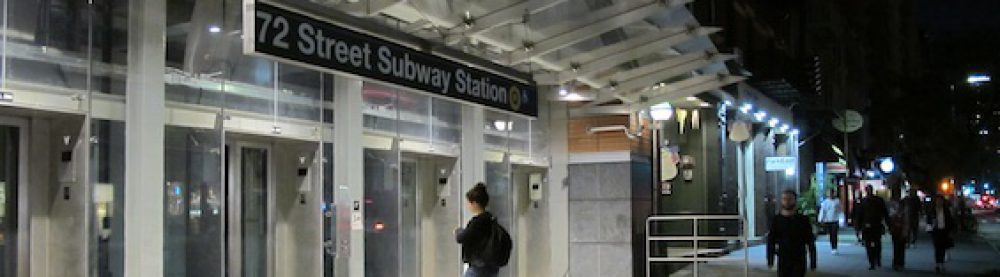
On Thursday a contractor for the MTA made a boo boo and drilled into a subway tunnel at the 21st Street Station in Long Island City. Its giant drill bit scraped an occupied F-line subway car. The contractor, Griffin Dewatering New England, apparently did not follow instructions. Two years ago an MTA contractor blew life-threatening debris into East 72nd Street in Manhattan. In both incidents, people were scared witless, but no one was physically injured. However, over the past year passengers on another MTA operation, Metro-North Railroad, have died. The National Transportation Safety Board delivered a scathing condemnation of Metro-North and its regulator this Tuesday. Sen. Richard Blumenthal (D-Conn.) called the Federal Railroad Administration “essentially a lawless agency, a rogue agency.” * This came after the NTSB investigated five accidents resulting in six fatalities, more than 100 injuries, and $28 million in damages in the past eleven months. The report found that Metro-North had sacrificed scheduled maintenance and safety to keep the trains running on time. Bad management and oversight of both Metro-North and the Metropolitan Transportation Authority at the highest levels is indicated and it adds to the irony of another story that appeared next to the NTSB story in print editions of the N.Y. Times: Jay Walder, chairman of the MTA from 2009 to October, 2011 is the new head of Alta Bicycle Share that operates the Citi Bike program. In July, 2011 the board of the MTA allowed Walder to break his six-year contract, which should have run until the end of 2015. Thus he was able to seize the opportunity to run the MTR Corporation that operates rail services in China. When Walder ran out on the MTA, instead of publicly chiding Walder for breaking his contract with the public, Gov. Andrew Cuomo and former mayor Michael Bloomberg offered nothing but praise. The MTA board sent him off with a party. Only Gene Russianoff, head of the Straphangers Campaign, said that Walder’s unexpected departure would harm the MTA. “There’s always a learning curve for new management, and this learning curve will occur during the period when they’re funding their incredibly important rebuilding program,” he said. “I don’t think it’s so hot.” As it turns out, Walder’s scarper wasn’t a good career move. This year in Hong Kong, MTR announced it would not renew his contract in a decision that was “mutual.” So if the MTA and government officials had required Walder to live up to his commitments he would still be working for the people of the region. Whether Metro-North and the MTA would have performed better and spared lives and revenue with him at the helm can never be known. All that’s known is that that the man who once oversaw subway, busses and trains in the New York metropolitan region is now running a 1000-bike program he hopes to expand to all five boroughs. He will relocate Alta from Portland, Oregon to New York and will bring 6,000 more bikes to New York City. Cyclists have the kind of clout that riders of public transit riders. This time Walder needs to succeed big. Do you think he run Citi Bike longer than the few years he gave the MTA? Longer than the few he was with MTR? Will the de Blasio administration demand more from him than the MTA did? Do you expect him to do a good job? Are his skills transferable? Please comment below.

  • CORRECTION The original post 10/31/14 erroneously reported that Sen. Blumenthal’s quote referred to Metro-North. He was actually referring to the Federal Railroad Administration. Attribution is correct in the linked N.Y. Times story.

Note to Met Museum Cafeteria: I’d like a side of atmosphere

It’s not enough for me that New York’s Metropolitan Museum of Art possesses Vermeer’s “Women With a Water Jug,” the Temple of Dendur and a large room full of armor. No, what I would like, truly, is to take pride in its cafeteria. That generic basement eatery could be anywhere, including a suburb in a declining Midwestern city. The posters that someone finally installed on its windowless walls have not improved the experience.

Graeco-Roman or 1930s Hollywood?

A nook at the Met Museum public cafeteria. Photos invoke 1930s Hollywood, not the Greek and Roman wing.

In the earlier public cafeteria space, art-lovers could munch on perfect medium-rare roast beef sandwiches in the aura of McKim, Mead and White’s marbled Roman atrium. That was taken over by the sublime Leon Levy and Shelby White Court of Classical Art.  Since then, the cafeteria has been déclassé, despite the high prices. In fairness, a few years ago the Prado’s cafeteria seemed plain, but its gazpacho imparted a cultural experience that was the best of Madrid, the essence of Spain.

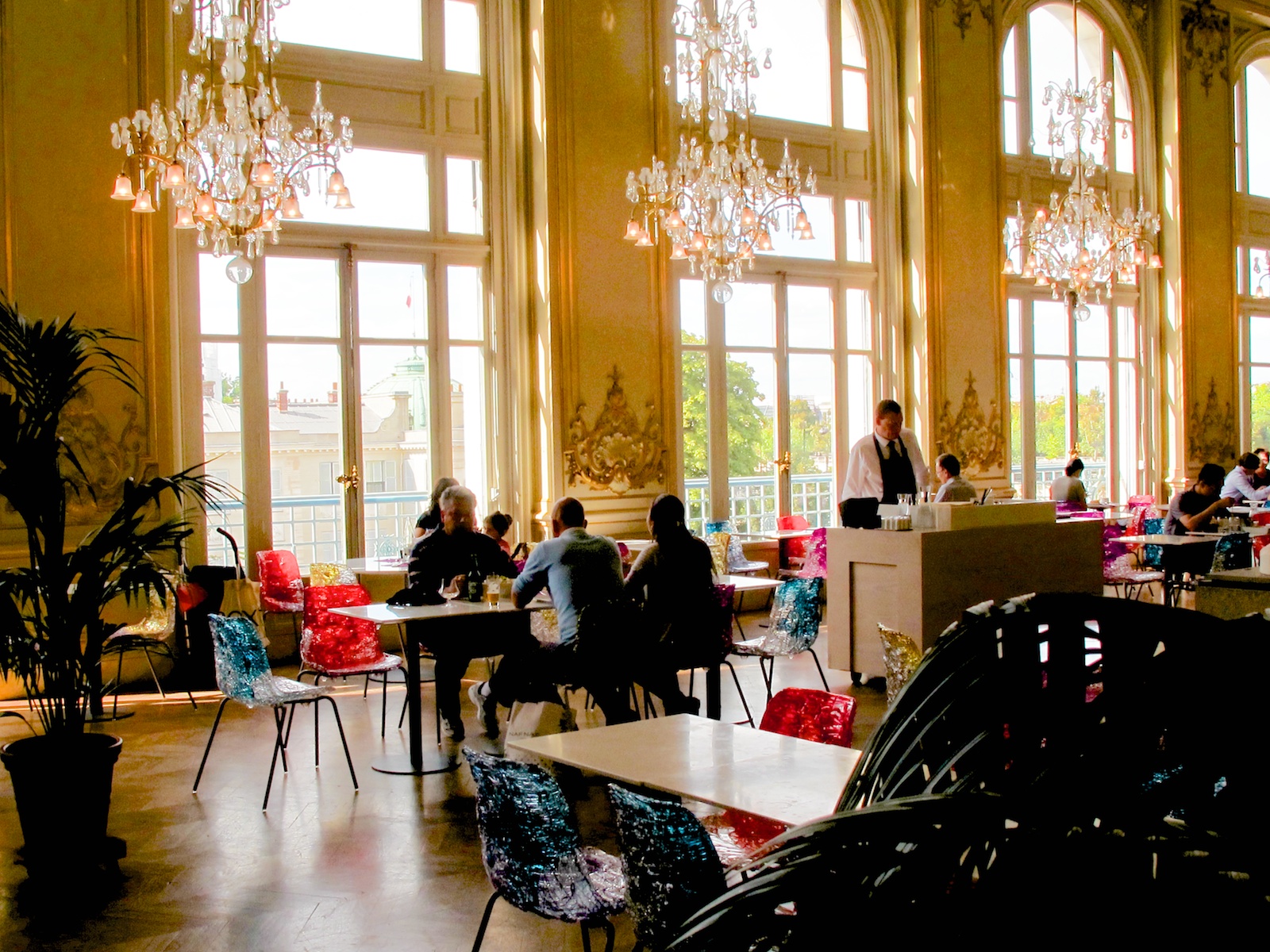
The Musée d’Orsay in Paris should be an inspiration to the Met Museum. The food twice is good as Met fare, which makes it seem half the price (a friend paid $19 at the Met cafeteria for a plate of indifferent mashed potatoes and green beans, whereas I paid $23 at the full service d’Orsay brasserie for a large serving of smoked salmon, crudités and bottomless bread basket that I shared with a companion). Price is of course tangential to  visual aesthetics.

At the Musée d’Orsay, patrons at the snack bar, formally known as the Cafe de l’Ours, can enjoy a view of François Pompon’s delightful sculpture of an imposing polar bear.

by Sophie Boegly, free image from Musée-d'Orsay

Cafe de l’Ours snack bar at Musee Dorsay

While the Bear Cafe is just right for many museum patrons, those who want a meal can go to the restaurant that was part of the original Hotel d’Orsay adjacent to the train station that became the Musée d’Orsay.

Musee Dorsay

Restaurant Hotel d’Orsay combining haunt French style and plastic chairs with panache

And for those of us with appetites and budgets just in the middle, there is the Cafe Campana brasserie designed by the Campana Brothers of Brazil. They also devised the set for Prokofiev’s Peter and the Wolf at the Guggenheim Museum in 2008.

Lively atmosphere with decor of art

Who could have a bad time at this brasserie designed by the Campana Brothers of Brazil with art piece room divider?

Yours for 25 euros!

Yours for 25 euros!

Providing a more imaginative experience at the Met Museum cafeteria could be monetized. Do as the French. Remember: Exit through the gift shop!


Are NYC Pedestrians Less Important Than Carriage Horses?

In New York City, biking safety is measured by pedestrian body count. Not too many individuals are killed by lawless bike-riders, therefore biking is safe.

Nonetheless, most people I know, even cyclists, report that they are terrorized by bike-riders on sidewalks and in crosswalks on a daily basis. It is poor sportsmanship to say that cyclists should obey traffic laws or that they are anything less than a public good. When I was hit by a delivery biker while I stood behind the pedestrian barricade at the Second Avenue subway construction site this summer, the useless safety guard was amazed that I could expect any assistance. That wasn’t her job description, apparently. She thought it was an explanation when she snapped, “I am here to help people.” Not to worry, I stopped limping the next day.

Well today Jill Tarlov, 58, was stopped completely. The Connecticut wife and mother of two died this morning after several days of brain death caused by cyclist Jason Marshall, 31, who struck her down near West 62nd Street in Central Park on Thursday. The N.Y. Times reported the incident as well as the passion of New Yorkers whose concern about lawless cyclists is habitually ignored. As of this posting, he has yet to be charged with a crime. The N.Y. Post reported that Marshall has boasted of speeding on this $4,000 bike on the website http://www.strava.com. As of this posting, he has not been charged with a crime.

Hopefully, since one specific horror can illuminate festering wrongs, Tarlov’s death will be as transformative as the knock-out punch thrown by former Baltimore Ravens running back Ray Rice against his then-fiancee. Revealed on a security video tape, it brought into focus the chronic violence against women that the National Football League and our Super Bowl-loving nation has long ignored. Now even the football commissioner has been shamed into paying attention.

Clearly, the city’s two-week police crackdown last month on cyclist law-breakers did not work. We need serious law enforcement every day, including the law that forbids anyone over the age of 14 from riding on the sidewalks. In addition, we need statues that require all cyclists to be licensed or registered and to wear large, visible registration numbers on their backs. Above all, cyclists must affix working headlights to their bikes and turn them on, as cars must, when twilight begins. Cyclists wearing black clothes in the black of even early black night are invisible to hapless pedestrians who dare to leave their homes after sundown.

On Monday morning as Tarlow’s death was announced, a woman wearing a Central Parks Conservancy volunteer tunic was at the accident site urging cyclists to obey posted notices that forbad bike riding on park pathways and also to get them to stop speeding through red lights. She told me she didn’t mind if they slowly rode through red ones (I do, however). For the most part, cyclists seemed to know they had to watch themselves. The volunteer told me, “I have seen the man who killed her many times. He speeds all the time. I do this volunteer work because I am a cyclist and I want it to be done right.”

Even so, cyclists know laws are not really for them. Tarlov’s husband was probably planning her funeral when I took these photos of the spot where she was struck down:

Scofflaw

The green light at left means that this biker had a red and should not be in crosswalk. Police presence did not faze him.


Future Killer?

Breaking the law at the scene of a brain death


Could he kill your parent or child?

This man rode away when volunteer told him to dismount when on a pedestrian pathway. In this photo he returns to ignore park rules and rejoin a female companion who dismounted and waited for him.

Outside the park, this cyclist grimaced and dismounted after I took her photo. Maybe she heard about Tarlov.

Outside the park, this well-heeled cyclist grimaced and dismounted after I took her photo. She knew she was doing the wrong thing. If I did this while waiting for a bus, what could police accomplish?

It’s time to get serious. Mayor deBlasio believes he had to take a principled stand again carriage horses. Let him take a stand against cycling scofflaws who ruin the quality of life of people who are trying to walk down a sidewalk or cross a street. CBS News, which employs Jill Tarlow’s widower, has promised to report on the issue. For most of New York’s media, that would make a real change. Here is the statement from Anton Guitano, Chief Operating Officer, CBS Local Media, and Peter Dunn, President, CBS Television Stations: “We are heartsick over the passing of our dear friend and former 1010 WINS Radio colleague Jill Tarlov. As we mourn the loss of our friend and console Mike and his family, we are committed to doing what we can to bring greater public awareness of the perils of unsafe and distracted driving by motorists and cyclists that endangers pedestrians. Far too many people have been killed or seriously injured on our streets.” To this I would add: Terrorized too.

Funny the rider in the photo lower left doesn’t look under age 14 to me.  Please comment and click on  “Leave a reply” below.


Send the Children Home

Multi-cultural New York City, through governmental and non-profit immigrant service agencies, is working to find shelter and other needed resources for the tide of unaccompanied children pouring over the southwest border of the U.S. from Central America. Since last October, according to the N.Y. Times, federal officials have sent 3,200 of these minors into New York State alone. One potential source of housing for them is a former convent in Syracuse.

Some attribute the influx of these hapless children to immigration policies that are more lenient to children than to adults. The Obama Administration blames the poor state of the economies of Central America. As for what is to be done now, some say turn the kids back immediately, others say they should be allowed to stay.

For myself, I am going with the opinion of my friend Milly, who has a life history of being pro-immigrant. A U.S. citizen since birth, she has done social work in Mexico, worked with immigrants arriving on these shores, and now teaches English to newcomers from all nations in New York City. She insists that the children must be sent back to their homes immediately. She has seen first-hand the horrors – robbery, rape and murder as well as exposure to the elements – that such children face on their journey from Honduras to the southwest border. Milly insists that any such travel must be blocked and discouraged. Certainly, it should not be rewarded.

I am left with two questions: First, did NAFTA, the North American Free Trade Agreement, deliver as promised? It seems not to have engendered the “certain” boost to the Mexican economy that would keep its people thriving at home. In the U.S., even factoring in automation, it deprived U.S. workers without college degrees of needed work, forcing them on social support at taxpayer expense. It was good for shareholders and intellectual property rights. It also dealt a big blow to unions. Learn about other outcomes here and see one of NAFTA’s proponents make a case for her work here.

Second question: How fast can we de-criminalize drug use and regulate and tax the sales of substances from marijuana to heroin? You can bet the drug lords of Mexico and the gangs they sub-contract to don’t want this to happen. Neither do those who live off the tax-funded U.S. prison system, which is supported by drug convictions and is, statistically speaking, the destination of many of today’s scarred and unaccompanied immigrant children.