Doctors Muzzled – – And Not by N95 Masks

A few days ago, in the midst of a lockdown because of the coronavirus Corvid-19 epidemic, a devastating tornado struck my hometown of Jonesboro, Arkansas. In part because everyone had been forced to stay home, no lives were lost although The Mall at Turtle Creek, the virtual town center if you don’t count Walmart’s, was pretty much flattened, cars were crumpled, and a passing freight train was turned into shards.

But there were two other reasons no lives were lost. First, residents took all the precautions they could because they believed the local news media, which warned in advance of the coming tornado. I was prepared hours before in the relative safety of locked-down Manhattan because a friend of mine posted photos on Facebook of her beautiful spring flowers because she realized they would drown in the coming rain.

Secondly, people knew what protections to take. Porsha McCoy and four others, for example, huddled together in a bathroom. “We just protected each other, we didn’t have anything to cover ourselves, but each other,” she said. “We could feel things, like we was going to get blown away. By the time we opened our eyes all we could see is the sky.”
Killer storms are as well accepted as summer heat in Jonesboro. In 1968, a tornado killed 34 people and injured 300. Five years later, in 1973, another one smashed through a commercial district, destroyed five schools, injured 200, and mercifully killed only five people. 

After the tornado hit March 28, my relatives in Little Rock texted a video of the twister swirling through Jonesboro’s outskirts and setting off a fiery blast. This burst sent me to the Internet where I found a Jonesboro story from days before that made me teary. A local commercial landlord, Clay Young, told his tenants not to pay their April rent so they could pay their employees instead. Surely there were other such kindnesses in the U.S. last month, although I haven’t read or heard of them in the news. The inspiring stories that have overshadowed everything else concern the valor of nurses and doctors risking their own lives to serve those racked with the contagion in our ill-equipped, poorly prepared hospitals.  


 That is what makes a report from Bloomberg news that hospitals are threatening and firing doctors and nurses who tell the press about their working conditions and the state of patient care during the coronavirus pandemic. Equally alarming is a revelation from ProPublica that many staffing companies are cutting the pay and other compensation of emergency room doctors and nurses, despite the relief these businesses will receive from last week’s $2 trillion stimulus package that includes deferring payroll taxes, suspending reimbursement cuts, and receiving advance Medicare payments.

How have our hospitals sunk so low when they are led by top administrators so capable that in the New York metropolitan region their annual salaries each top $1 million, based on a 2016 survey? When this pandemic ends, we have to face how careless our nation has become, which includes the cost-saving short-sightedness of the hospital industry. Without public pressure, there will not be the needed storm of reform. Devastation, as the people of Jonesboro know, always comes again.

Please leave your thoughts in the box below.

Northwell, Check Your Messages

Our financial institutions were supposed to be too big to fail, but many failed anyway. Are New York hospitals now too big to succeed? In my relatively minor experience, yes they are. In the more disastrous cases of several friends, yes as well, but that would have been their story to tell.
Here’s what happened to me: Northwell Health took six days to send a refill prescription for eye drops to my pharmacy. On a Friday afternoon I phoned Northwell, worked my way through the dozen phone commands until I reached its “medication renewal” voice mailbox and left all my information. I knew nothing would be done until Monday. Wrong. Not until the following Thursday, after daily calls from me as well as my pharmacy, plus at least one fax, did I have my refill.
How to make this tedious story, which most New Yorkers have lived through several times, interesting? It is important because we usually let these things go. They happen to everyone and patients are so happy when the experience is over, or we are are still so sick, that we don’t have the energy to demand competent care.
Five days after my first call for a refill, on a Wednesday, I still had no response. I fought my way through Northwell’s phone system and reached a human being in my doctor’s office. She said they would send it to the pharmacy immediately. That afternoon, a woman with a Spanish accent too thick for me to truly understand phoned to say that the prescription was at Walgreens. I repeated everything she told me to verify that I had understood her. Later I phoned Walgreens pharmacy, confirmed that I had indeed reached the pharmacy, and the man I spoke with said my prescription was in. He volunteered that it was eye drops. Three hours later I went to pick them up. The story changed. Three pharmacists told me that the prescription had not been received. The manager said that no man was in the pharmacy at that time I phoned so no one could have said that. However, the man I spoke with offered me the information that it was eye drops. If he was somewhere else he has remarkable powers of ESP. I would like to contact him about the stock market.
The next morning, on day six, I again phoned my doctor’s office at Northwell and said that, despite what their office had told me the day before, no prescription had been phoned in. While I waited on hold I heard a commercial for Lenox Hill Hospital. I thought it was an act of God telling me to get away from Northwell, but no, it turns out that Northwell owns and operates Lenox Hill as well, part of the monopolistic, patient-harming trend of consolidation in our nation’s hospitals. This hurts patients (examples furnished upon request) but enriches hospital administrators, shareholders and maybe, somehow, physicians who keep their mouths shut about how bad care has become.
Anyway, a secretary swore they had already sent in the prescription, would do so again, and hopped off the line. Twenty minutes later, the sixth day after my initial request for a refill prescription from Northwell, someone texted me that the office had sent me a prescription. And reader, it had!!!
Here’s what worked: I do have a smartphone – don’t all patients? I am strong and healthy enough to walk up and down Second Avenue during heat advisories in fruitless visits to my pharmacy when promised prescriptions do not arrive. Also, I knew to refill my prescription well before my medications ran out. Next time I shall give them a month, instead of a week.
A Northwell Health factsheet says it is “more than 69,000 people looking at health care differently.” I did have a different experience than I expected. I lived, but someone else won’t.
Please put your thoughts and suggestions in the box below.

Upgrade Subway Signals — Phase Out Phase II

This week’s Voice presents an excellent article by Aaron Gordon.

It says all that needs to be said. Here it is:

Maybe We Didn’t Need the Second Avenue Subway After All
The latest ridership numbers show that the MTA spent more than $300,000 for each new daily straphanger attracted by Cuomo’s much-heralded Upper East Side line

By Aaron Gordon July 18, 2018

All eyes were on Governor Cuomo when he celebrated the opening of the Second Avenue Subway in December 2016. Dennis Van Tine/AP Images
When the calendar flipped from 2016 to 2017, Governor Cuomo rode the subway. As you may recall, this was no ordinary subway trip: It was the inaugural run of the Q along its new route, down from the 96th Street terminus of the shiny, new Second Avenue Subway. You know, a ribbon cutting. Our governor loves ribbon cuttings.

With last week’s release of station-by-station ridership figures for 2017, we can finally learn the impact this long-awaited subway extension had on the system. As it turns out, the Second Avenue Subway is undoubtedly a benefit, but at $4.5 billion for just the three stations built so far, a very expensive one. And the stats also tell us much more about the problem the line was built to solve — and raise the question of whether that $4.5 billion would have been better spent elsewhere.

The Second Avenue Subway’s primary reason for existence was to lighten the load on the overburdened 4/5/6 Lexington Avenue line, the busiest subway corridor in North America after the Second and Third Avenue Els were torn down mid-century. This was a worthy goal, and to some degree, the new line accomplished this: The five Lexington Avenue stops closest to the subway extension — 96th Street, 86th Street, 77th Street, 68th Street–Hunter College, and Lexington Avenue–59th Street — saw 17,377,828 fewer swipes into those stations last year, or about 47,600 per day.

Meanwhile, the three new Second Avenue Subway stations experienced almost 21.7 million trips last year, or just a hair shy of 60,000 per day. After factoring in large ridership changes at other nearby stations — the Lexington Avenue–63th Street F/Q station saw a 1.3 million bump in trips, while the Fifth Avenue–59th Street N/R/W had 560,000 fewer — the total change in ridership after the Second Avenue line opened nets out to just a hair more than 5 million additional subway riders in 2017, or about 14,000 per day.

This is greater than officials projected in terms of ridership gained: MTA planners didn’t expect much new ridership from the Second Avenue Subway, knowing that it’s only two blocks from an existing subway. But in the grand scheme of New York City transit, it’s a pretty low number; it’s about the same number of riders who take the B36 bus between Coney Island and Sheepshead Bay each day.

But since construction began on the Second Avenue Subway in 2009, the subway’s performance has steadily declined to the point where it is now in crisis. The Second Avenue Subway’s opening was a short-lived respite of good news from the otherwise constant barrage of nightmarish headlines. State of Emergency, Subway Action Plan, declining performance, you know the rest.

At best, the Second Avenue Subway is the lone bright spot in an otherwise concerning trend of declining public transit ridership. Even with the increase in ridership on the Upper East Side thanks to the Second Avenue Subway, Manhattan still lost 10,821,930 subway trips last year. This ridership drop is almost certainly due to the increasingly poor service, which itself is a result of maintenance backlogs, antiquated technologies, and questionable management decisions.

As I have previously reported, while tunnel-boring machines were grinding their way underneath Second Avenue to relieve the 4/5/6, the MTA was installing unnecessary signal timers on the Lexington line that ended up reducing its capacity. The New York Times later found that in June and July of last year, during the average weekday rush hour window, 57 scheduled trains on the 4/5/6 simply do not run. Those ghost trains alone could have fit the number of riders who switched to taking the Second Avenue Subway.

Indeed, at the time the MTA was justifying the Second Avenue Subway, one of the key words involved was “overcrowding” — as in, crowding on the 4/5/6 was causing delays, and the only feasible way to address that was to build the Second Avenue line. This was the prevailing logic in 2009, and even for much of 2017 after the Second Avenue Subway was completed. Yet the new transit chief, Andy Byford, has since declared overcrowding is not, and never has been, the root cause of delays. Overcrowding is the result of delays, not the cause.

We know now that the Second Avenue Subway could not possibly have been the most cost-effective way to relieve crowding on the Lexington Avenue line. That would be upgrading the signals to Communications-Based Train Control, or CBTC. One of the first lines Byford wants to tackle is, in fact, the 4/5/6 from 149th Street–Grand Concourse in the Bronx to Nevins Street in Brooklyn. Doing so would allow the MTA to run trains much more efficiently, increase capacity, and turn those ghost trains into real trains.

This project alone would provide a benefit to Lexington Avenue line orders of magnitude greater than the Second Avenue Subway for a fraction of the cost. (Re-signaling the Queens Boulevard line from Kew Gardens–Union Turnpike to 50th Street is expected to cost $425 million; the Eighth Avenue line from 59th Street to High Street has a preliminary estimate of $375 million.) But the main holdup for Byford’s plan is he needs the money. Oh, if only he could have, say, $4.5 billion available, enough to upgrade most of the subway system to CBTC.

Most transit experts will tell you that thanks to decades of apathy the subway needs to build extensions and rapidly upgrade its existing infrastructure. No disagreement here; the best version of New York City is one where we can do both. But, as the last several decades and Byford’s ongoing efforts to secure funding illustrate, that isn’t the New York we have. Instead, the MTA is working on scraping together $6 billion for Phase II of the Second Avenue Subway, which will take it up to 125th Street — at that price tag, the MTA could almost certainly re-signal the entire subway system. The question isn’t why the Upper East Side can’t have nice things, but why, with so many dire, urgent needs across the system, the Upper East Side should be disproportionate benefactors.

In any case, the Second Avenue Subway extension has now been built, so we must do our best to enjoy it. The people who used to have a fifteen-minute walk to the subway but now have a mere ten-minute walk must savor those precious moments. The straphangers still taking the 4/5/6 ought to bask in the extra space they now have. Take an extra second to enjoy the world-class art in the new stations. Somebody has to, because Governor Cuomo won’t. He hasn’t ridden the subway since. After all, there haven’t been any ribbon cuttings.
Must-reading on NYC’s subways…

Kudos to the N.Y. Times for its investigation into how the city’s subway system became the dangerous disaster it is today. With so many examples to choose from, the reporters omitted my favorite horrific Metropolitan Transit Authority blunder – the $530 million “renovation” of the South Ferry station that opened in 2009 and was knocked out of service  by Hurricane Sandy three years later as a storm surge poured through its entrances and crippled the entire system. It turns out that those who designed and approved the upgrade early in the 21st century forgot that the South Ferry station was next to New York Harbor. The MTA team neglected to engineer safeguards against rising sea levels and inevitable storm surges.

Not to worry about missing that one — read about how Governor Andrew Cuomo forced the MTA to used $5 million of its budget to prop up three upstate state-run ski resorts that were adversely impacted by a warm winter.

Readers can pick their own favorite blunders from the newspaper’s fine reporting here.

Please comment in the box below.


Williamsburg Tickets Cyclists!

More cyclists than commercial truck drivers in North Brooklyn are receiving tickets, according to NYPD data. As Gwynn Hogan reports in DNA Info,  between January and the end of September, cyclists in Williamsburg were ticketed 1,160 times for violations like running red lights and riding the wrong way on a one-way street. This is compared to 463 tickets written to commercial trucks for violations like texting while driving or not wearing seatbelt. I think we are supposed to be appalled that law enforcement is harder on cyclists than commercial truck drivers, but I am glad that bikes are getting some attention. If cyclists want to break laws with impunity, they should pedal over to Manhattan. It seems to me that their luck is better there.

Please comment in the space below.

Library Rose Room Reopens to All!

Given that the third floor of The Stephen A. Schwartzman Building on Fifth Avenue, formerly known as the main branch of The New York Public Library, is now as densely packed with visitors as Times Square or the #6 subway line, I think it is time that the NYPL board and administrators, who encourage this crowding, hire a grad student to dress up as a topless Jane Austen. She could pass her drawstring bag around for funds. Maybe they could add a Bob Dylan. Literature has super heroes too.
Even if the likes of students, scholars, researchers and writers are no longer enough to justify fund-raising among the 1 percent, the larger issue is that yet another bastion of excellence is destroying itself. Let’s all go visit a fire station to make those cost-effective too. Currently, the only people allowed to enjoy these publicly-owned properties are those who need to be there. Let people in so they can slide down the poles!
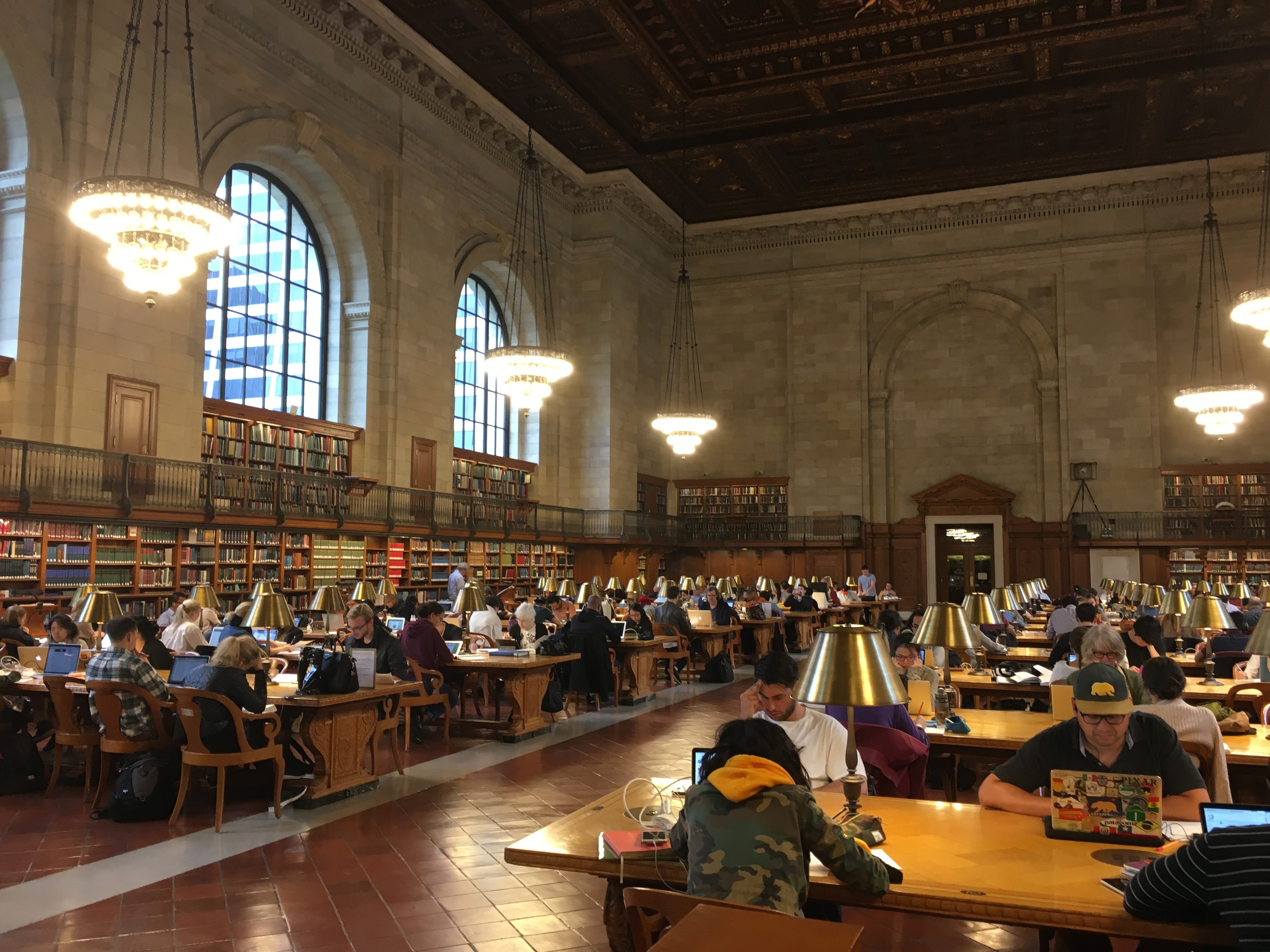
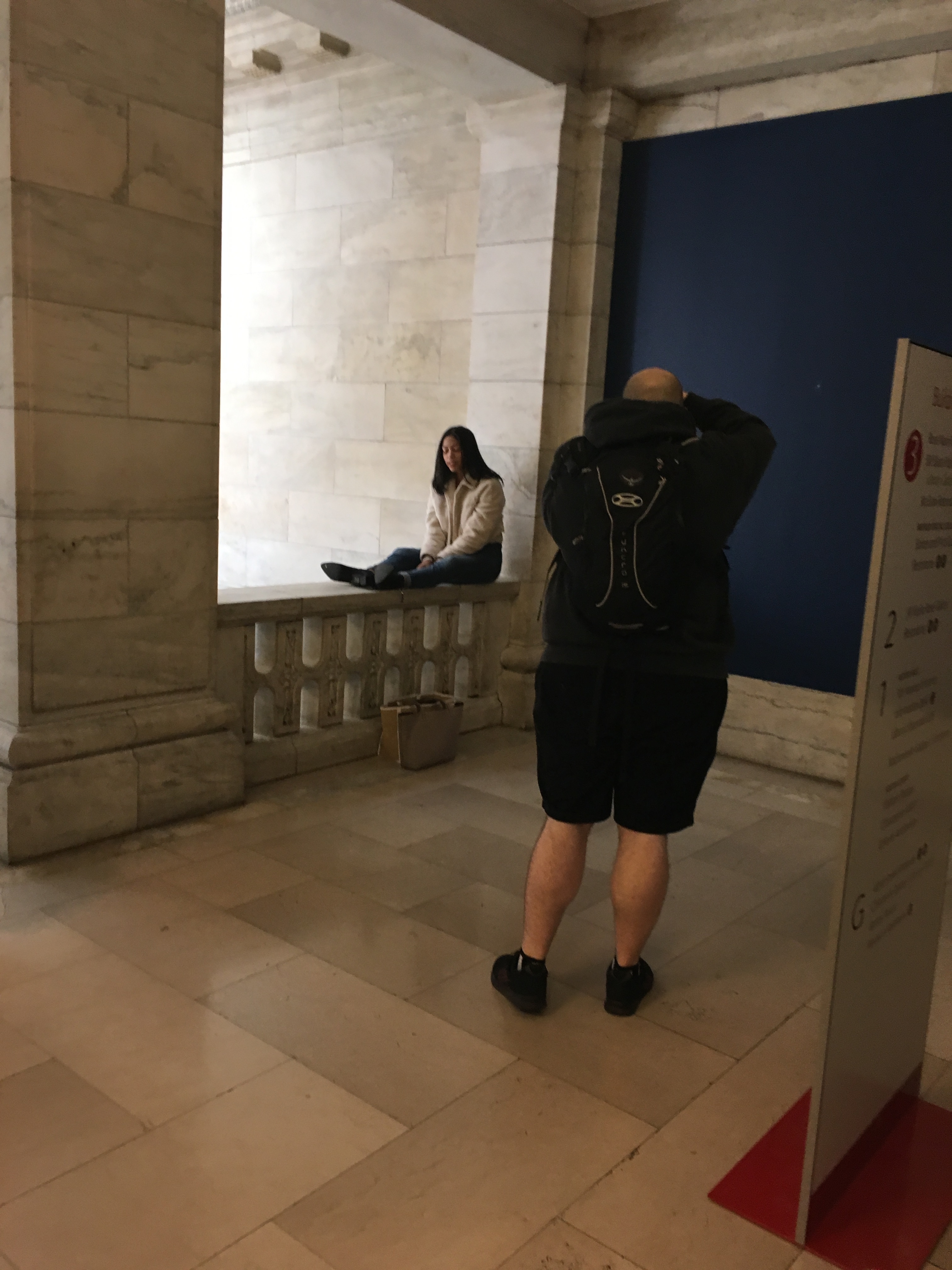
Of course the magnificent Fifth Avenue library building should be appreciated by as many as possible, but the hordes now overwhelming the guards and librarians need to be actively policed. This month’s NYPL press release says of the Rose Reading Room: “The entire Room is designated for research and quiet study and there is a small viewing area where visitors can admire and take non-flash photography of the room and ceiling.” That is not the situation unfolding. (text continues below the photos)

NYPL patrons as zoo animals

If you can’t get to the zoo, photograph in the Rose Room

Scholars use the Rose Room

Patrons fill the North Rose Reading Room awaiting close-ups to be taken by visitors coming in from the rain

Visiting teens like to stand on this balustrade.

Liability issues ahead, NYPL!

So, here are some suggestions on how to re-civilize the former main branch of The New York Public Library:

  1. Inform all library guards about the rules of behavior for those wandering and photographing the reading and research rooms and its true patrons. Have them enforce the rules, which they are trying to do now with only moderate success.
  2. Designate guards to take the place of those going on their well-deserved breaks since rubberneckers swarm in taking photos and dragging children unless a guard is standing in the door of the north reading room (which is nearly identical to the south room and is supposedly off-limits to those not using NYPL materials).
  3. Ban strollers and children under the age of 12 from both reading rooms or, better, yet from the entire third floor.
  4. Rope off more lane lines so those attempting to request books can get through the clot of rubberneckers standing in doorways.
  5. Increase your toilet paper budget and improve plumbing because the bathrooms are overwhelmed, as are cleaning people.

  6. Increase your liability insurance because someone is going to get hurt. Before the Rose Room closed, I panicked when I saw a teenager standing on the balustrade on the third floor north side stairwell to impress his terrified buddy. Had the daredevil fallen three stories down to the hard marble floor his grieving parents would have had quite a payday. The building might have had to be sold and turned into condos to pay the legal judgement. Could that be idea? That Wells Fargo guy could buy an apartment in the Rose Room. Please comment in the reply box below.

Airing Facts about AIRBNB

If the legal owner/occupant of a residence is in residence when he/she rents out their home, I have no objection. However, if they are not present, if they permit friends, family and strangers to occupy their property, it is their neighbors (as I have learned) who will bear the brunt of visitors’ carelessness, cluelessness and just plain not knowing that every time they drop their combat boots on the bare floor, the person living downstairs will suffer. Here’s a wonderful explanation about the dangers and dishonestly of AirBNB — and why it must be closely regulated — from http://www.gothamgazette.com and the hotel industry.

Please comment below.

Bill Cunningham: Nobleman of Style

Bill Cunningham, the street photographer, cyclist, one-time milliner and incomparable New Yorker died this week at 87 and none will ever take his place. He had such a reverence for life and so keen a sense of the sacred that he was able to discern that even fashion has a soul. His best comment ever on his N.Y. Times blog went something like this: “People say that New York isn’t what it used to be. Are they crazy? (his voice rising) Have they seen the wisteria?”

Here is a selection of his many blogs, a link to the wonderful documentary about him, and photos that I had the gall to snap when I found him at work on his beloved 57th Street:


Diversity Is MIA at Halftime


Since this year’s Oscars nominations inspired a worthwhile discussion of diversity, I’ve been waiting for the entertainment media to say more about inclusion – or the lack of same – at the Sunday Super Bowl halftime show. None of the vanilla-talking CBS announcers mentioned the appearance of The Youth Orchestra of Los Angeles. Nor did I hear those boys mention Gustavo Dudamel, the charismatic music director of the Los Angeles Philharmonic. If they did, it wasn’t enough, even though they fell over themselves promoting Beyoncé and Bruno Mars. (Chris Martin, not so much).

On Monday the twitterverse and post-show analysts gave Chris Martin flack for being less vivid than Beyoncé and Bruno Mars. He received scant credit for generously inviting them to join him on the show in the first place. Nor was Coldplay’s front man hailed for inviting The Youth Orchestra of Los Angeles to back him up. Perhaps he would have gotten his props if he had featured dozens of women cavorting in thongs. That worked for others.

I was in on the Dudamel-YOLA secret because I am a regular listener of the classical music station WQXR. It became my go-to background station when I realized it would keep me in my chair. Stravinsky’s rousing Firebird, unlike Katy Perry’s Firework, is impossible to sing or dance to (except for those on pointe).

WQXR hosts in the week leading up to Feb. 7 mentioned that Dudamel would be appearing with YOLA, the group of disadvantaged young musicians he founded. This led me to believe that I would see something generous as well as fun at the Super Bowl halftime. I thought the uninitiated would discover the joys of classical music. Not at all, as it turned out. However, one did see some diverse if uncredited faces behind Martin as he ran around bringing the camera to as many of them as possible. Asians! Latinos! Possibly a blonde! Parts of a few kids were glimpsed in the tight shots of Martin, Beyoncé and Mars, but mostly it was their clothing.

Those kids were happy. I’m hopping mad. So here’s my new song of choice: Coldplay’s Life in Technicolor. Since it includes singing, working hours I will go with Vitamin String Quartet’s version.

Please comment below, especially if, unlike me, you heard mention of Dudamel or YOLA. This is a blog of facts

A Small Midtown Business Survives!

Just in time for the Lenten season comes the miracle of a resurrection — Jim’s Shoe Repair is saved! Having now signed a new lease for the space at 50 E. 59th Street that it has occupied since 1932, Jim’s is a rare example of a successful and hallowed New York City business beating back the encroachment of a faceless mega-corporation. Some eighteen months ago the adjacent Duane Reade store, owned by Walgreen, tried to take over the space of the family-owned business, reportedly because to wanted to install refrigerators. Landlord SL Green Realty was ready to kick Jim’s out and it looked like another small New York City business would be swallowed in the maw of a national chain. (See May 2, 2014 post for background) 

Although SL Green drove Posman Books in Grand Central Station out of business, the firm and its tenant Walgreen decided to relent in the case of this repair shop. Joseph Rocco, grandson of the founder, credits his lawyer Bill Brewer who worked pro bono. “Without Bill Brewer we would be out of here,” he said. “He brought his shoes in here one day and said, ‘What do you mean you are losing your lease? You are not losing your lease.'” Rocco also acknowledges the help of Fox 5, the N.Y. Daily News, bloggers who reported on their plight, and customers who signed their petition. Surely it also helped that customer Kim Cattrall was bringing in a black handbag for repair when the Daily News came to do its story.

The Roccos were determined to save their business and looked for another location. They did manage to find one last fall, and they thought they had a deal. However, that fell through when their prospective landlord dropped them for another tenant who offered more money. Disaster loomed until just before Thanksgiving when Brewer phoned Rocco, inquired if he was sitting down, and said that SL Green had agreed to renew. By Valentine’s Day the papers were ready. Could it be that mega-businesses like Walgreen, and even Real Estate Board of New York members like SL Green, care about their image? Maybe this time.

The survival of Jim’s is a rare victory for those who love New York City and who fight to help its people to thrive. However, more than blogs and Kim Cattrall are needed if even one more small business is to be saved. Today a stroll up Madison Avenue from Jim’s to East 72nd Street offers a visit of at least one empty store front on every block.

Last July, Danny Meyer wrote in the N.Y. Times about the threatened closure of his Union Square Cafe and called for New York City to create a body like London’s Rent Assessment Panel that has helped to preserve neighborhoods. Recently Mayor Bill de Blasio summoned the perfect metaphor when he said that New York City should not be a “gated community.” Nor should it resemble a strip mall in Stamford, but it does. Within a two block radius of my apartment building on the Upper East Side there are two Duane Reades and two Walgreens, plus a CVS. We have more bank branches than delis, which is no accident because the banks took over the spaces of the family-owned food shops that all used to thrive in the days of commercial rent control. If the city can’t bring back fruitful regulation then it must explore the creation of an arbitration panel for commercial rent rates or a similar mechanism that will promote New York’s economic diversity. If the city’s business elites can’t bother to figure out how they can profit from the economic well-being of residents, let them at least think of the tourists. Those Stanford strip malls aren’t much of a draw to all those people that are flying in from Beijing and Rio. Please scroll down to the “Leave a reply” box and comment.