Library Rose Room Reopens to All!

Given that the third floor of The Stephen A. Schwartzman Building on Fifth Avenue, formerly known as the main branch of The New York Public Library, is now as densely packed with visitors as Times Square or the #6 subway line, I think it is time that the NYPL board and administrators, who encourage this crowding, hire a grad student to dress up as a topless Jane Austen. She could pass her drawstring bag around for funds. Maybe they could add a Bob Dylan. Literature has super heroes too.
Even if the likes of students, scholars, researchers and writers are no longer enough to justify fund-raising among the 1 percent, the larger issue is that yet another bastion of excellence is destroying itself. Let’s all go visit a fire station to make those cost-effective too. Currently, the only people allowed to enjoy these publicly-owned properties are those who need to be there. Let people in so they can slide down the poles!
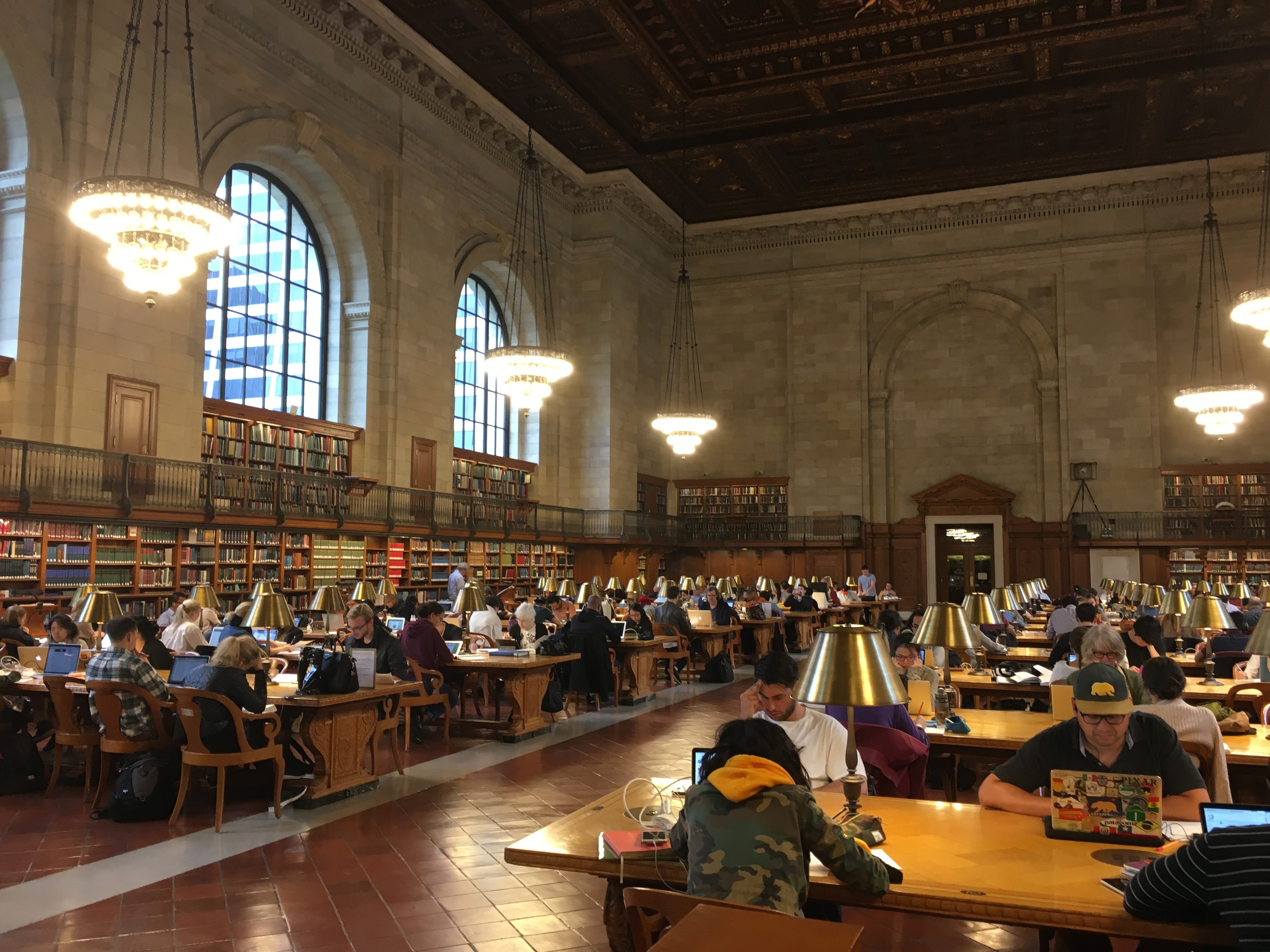
Of course the magnificent Fifth Avenue library building should be appreciated by as many as possible, but the hordes now overwhelming the guards and librarians need to be actively policed. This month’s NYPL press release says of the Rose Reading Room: “The entire Room is designated for research and quiet study and there is a small viewing area where visitors can admire and take non-flash photography of the room and ceiling.” That is not the situation unfolding. (text continues below the photos)

NYPL patrons as zoo animals

If you can’t get to the zoo, photograph in the Rose Room

Scholars use the Rose Room

Patrons fill the North Rose Reading Room awaiting close-ups to be taken by visitors coming in from the rain

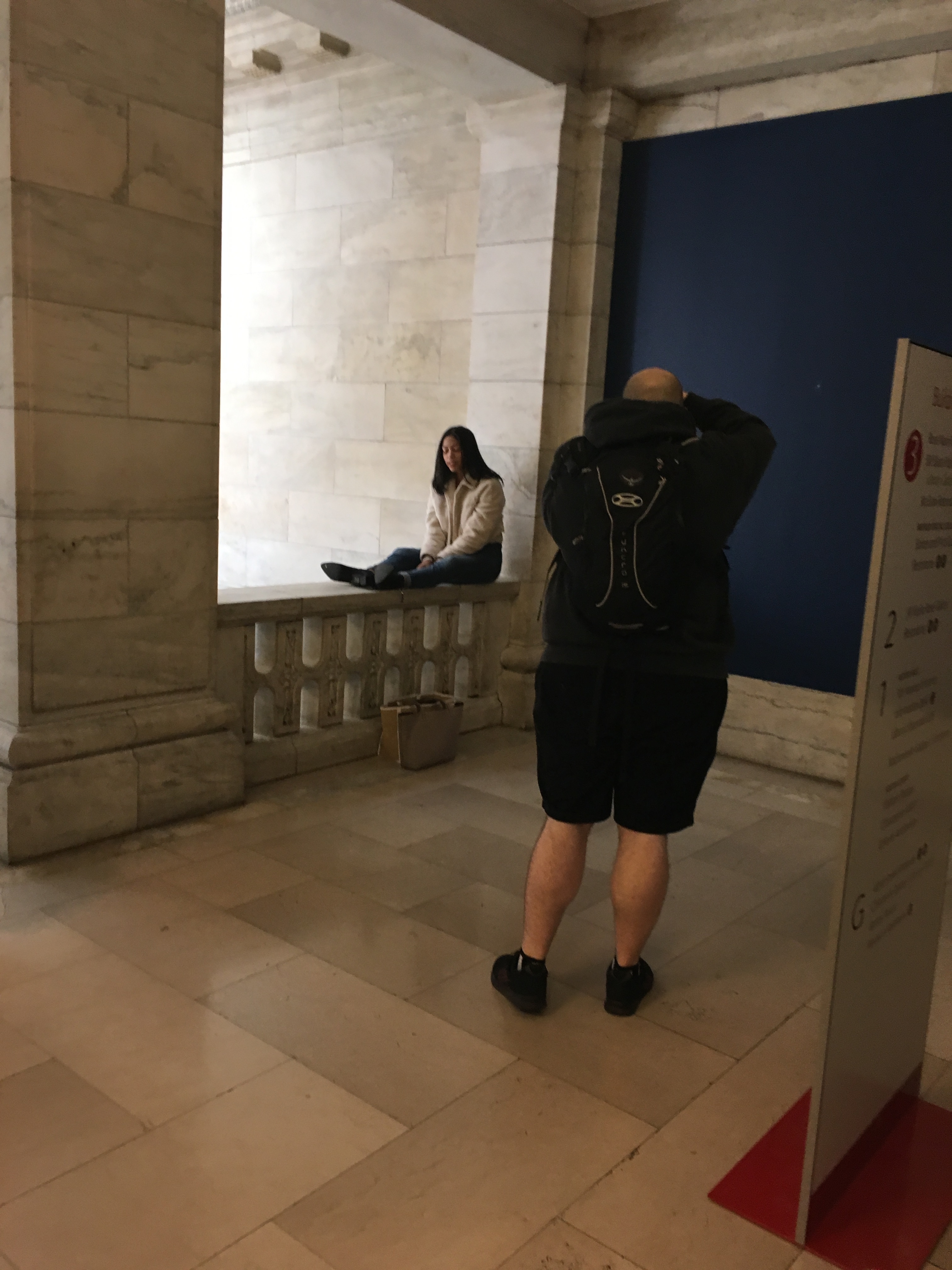
Visiting teens like to stand on this balustrade.

Liability issues ahead, NYPL!

So, here are some suggestions on how to re-civilize the former main branch of The New York Public Library:

  1. Inform all library guards about the rules of behavior for those wandering and photographing the reading and research rooms and its true patrons. Have them enforce the rules, which they are trying to do now with only moderate success.
  2. Designate guards to take the place of those going on their well-deserved breaks since rubberneckers swarm in taking photos and dragging children unless a guard is standing in the door of the north reading room (which is nearly identical to the south room and is supposedly off-limits to those not using NYPL materials).
  3. Ban strollers and children under the age of 12 from both reading rooms or, better, yet from the entire third floor.
  4. Rope off more lane lines so those attempting to request books can get through the clot of rubberneckers standing in doorways.
  5. Increase your toilet paper budget and improve plumbing because the bathrooms are overwhelmed, as are cleaning people.

  6. Increase your liability insurance because someone is going to get hurt. Before the Rose Room closed, I panicked when I saw a teenager standing on the balustrade on the third floor north side stairwell to impress his terrified buddy. Had the daredevil fallen three stories down to the hard marble floor his grieving parents would have had quite a payday. The building might have had to be sold and turned into condos to pay the legal judgement. Could that be idea? That Wells Fargo guy could buy an apartment in the Rose Room. Please comment in the reply box below.

Sweep Up Street Fairs, Please!

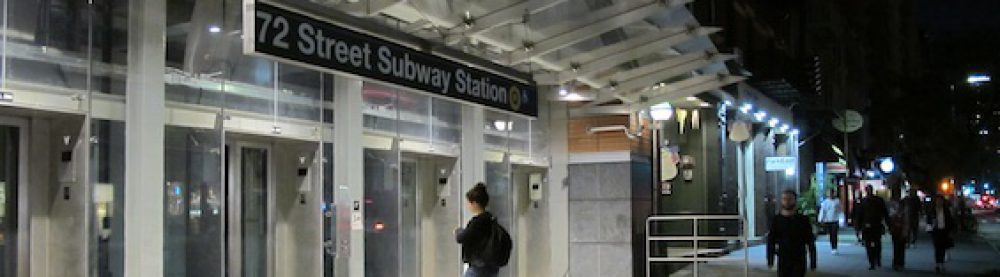
One good thing has come from the $4.5 billion of taxpayer money spent to construct the three stations that will comprise the Second Avenue Subway: over the near-decade of destroying small businesses and jobs, and undermining the health of residents, this project that was first (and better) developed in 1929 put an end to the Second Avenue Street Fairs.

I had made an annual ritual of slamming my windows to block carcinogens from burning meat snacks while I hoped to mute the cacophony of screaming drum-beaters who could not find a tune. However, the MTA’s claim that it will finally be opening those subway stations at 72nd, 86th and 96th Streets means that the fairs will be coming back. Hello tube socks and other merchandise that discount stores have rejected! Multiple welcomes to  vendors of rugs and schmattas who appear at every street fair one tries unsuccessfully to avoid! With you all come increased air pollution from busses and cars stalled in detours. Gone will be hours of human life lost while idling in lung-killing traffic. However, we will again finally see what our police officers look like because they will be present making overtime protecting us at these generic events.

Nonetheless, there could be reason for the audacity of hope. Writing in Politico, Laura Nahmias reports that the de Blasio administration plans to make New York City’s ubiquitous street fairs less corporate. Here is her story:

Mayor Bill de Blasio’s administration is proposing changes to the city’s street fairs intended to end the corporate flavor of many of the festivals, addressing a long-standing complaint from civic groups and elected officials that the fairs are a costly headache and do little to benefit the communities where they’re held.

Under proposed rules scheduled for a public hearing on October 13, at least fifty percent of vendors participating in a street fair would have to be businesses with locations inside the same community board where the event is being held. That proposal marks a major change that could remake the character of the roughly 200 street fairs the city currently allows each year.

The proposed changes, which must undergo a period of public comment before being approved and which would go into effect in 2017, were met with delight by Manhattan City Councilman Dan Garodnick, who has been pressing for reforms to the city’s street fair policies for years.

“My complaint is that they are generic and that they are too frequent with too little community benefit,” Garodnick said.

“A street fair should be a small, friendly community event, which people in the neighborhood identify with and enjoy. Many of them have just become a carbon copy of one another,” he said.

Currently, Garodnick said, the fairs “sell sausages and socks and cell phone cases and pashminas on every block and there’s not a hint of local flavor, other than perhaps the sponsoring organization which they are required to have.”

Since 2004, the city has had a moratorium on granting permits for any new street fairs, after the New York Police Department complained about the excessive burden the fairs placed on its resources. The fairs and festivals, most of which are concentrated in just three community board districts in Manhattan (in the areas around the West Village, Chinatown, Lower East Side, Greenwich Village, Midtown, Times Square, the Flatiron and parts of the Upper West Side), required officers to be diverted from their daily duties and drove up NYPD overtime costs.

New York City earned $1.6 million in vendor fees from more than 300 street fairs in 2010, but the events cost $4 million in overtime pay for the police officers staffing them, the Daily News reported that year.

Meanwhile, outer borough elected officials said their communities were left out of the capped street fair market, putting the burgeoning local businesses of the neighborhoods beyond Manhattan at a disadvantage. And last year, the de Blasio administration began eyeing the possibility of changing the regulations to enable outer boroughs to host more of these events. The administration sent surveys to local businesses and found significant interest in outer borough street fairs.

Under the proposed regulations, there would be geographic distribution of street fairs — no more than 200 street fairs could be held citywide each year, and no more than 100 of them could be located in Manhattan. Each community board would be limited to 20 street fairs annually.

The proposals are “a step in the right direction,” said Jonathan Bowles of the Center for an Urban Future, which in 2006 published a report calling for the city to “rethink” its “bland and generic” street fairs.

“One of the big problems with street fairs was that so many of the vendors weren’t even from New York City,” Bowles told POLITICO New York in an interview. “The fairs week in and week out were dominated by the same few vendors, which is one of the reasons why they were boring and generic.”

Bowles said the city ought to consider opening vendor opportunities at fairs to local and independent businesses from outside of the community boards.

“We’ve criticized street fairs in the past, but not on principle. These could be so amazing for New York City,” he said. In the ten years since the Center for an Urban Future first published its report, many new and interesting street fairs and festivals have popped up, particularly in the outer boroughs, Bowles said.

“We’ve seen, since we started writing about this issue, how New York City has benefited from all these incredible markets, like Smorgasburg, the Brooklyn Flea, the Union Square holiday market.

“New York City has so many independent and entrepreneurial businesses, but so few of them have been represented in street fairs that it’s been a missed opportunity,” he said.

But some of the city’s largest street fair operators said they plan to fight the proposed rule. Todd Berman, the head of Clearview Festival Partners, which is one of the city’s largest street fair and festival operators, applauded the idea to make street fairs more inclusive, but called the new proposed regulations “draconian.”

“It is not realistic or achievable to reach the fifty percent requirement that they’re proposing and have the ability to generate a profit off of the event,” Berman said. “This regulation of fifty percent, it’s a death sentence to street festivals,” he said.

Berman, who operates many festivals outside of Manhattan, said the 100 festival cap on all outer-borough festivals was insensitive.

“I think this mayor has run on a platform of this being one city, but the boroughs are clearly being given the short end of the stick,” he said.

Thus ends Nahmias’ story. I would like to see all fairs banished from Manhattan, or at least confined to one area way downtown, or even in midtown where those who like them can find them with confidence. Please leave a comment by clicking on the lines below.
Airing Facts about AIRBNB

If the legal owner/occupant of a residence is in residence when he/she rents out their home, I have no objection. However, if they are not present, if they permit friends, family and strangers to occupy their property, it is their neighbors (as I have learned) who will bear the brunt of visitors’ carelessness, cluelessness and just plain not knowing that every time they drop their combat boots on the bare floor, the person living downstairs will suffer. Here’s a wonderful explanation about the dangers and dishonestly of AirBNB — and why it must be closely regulated — from http://www.gothamgazette.com and the hotel industry.

Please comment below.

Bill Cunningham: Nobleman of Style

Bill Cunningham, the street photographer, cyclist, one-time milliner and incomparable New Yorker died this week at 87 and none will ever take his place. He had such a reverence for life and so keen a sense of the sacred that he was able to discern that even fashion has a soul. His best comment ever on his N.Y. Times blog went something like this: “People say that New York isn’t what it used to be. Are they crazy? (his voice rising) Have they seen the wisteria?”

Here is a selection of his many blogs, a link to the wonderful documentary about him, and photos that I had the gall to snap when I found him at work on his beloved 57th Street:


Diversity Is MIA at Halftime


Since this year’s Oscars nominations inspired a worthwhile discussion of diversity, I’ve been waiting for the entertainment media to say more about inclusion – or the lack of same – at the Sunday Super Bowl halftime show. None of the vanilla-talking CBS announcers mentioned the appearance of The Youth Orchestra of Los Angeles. Nor did I hear those boys mention Gustavo Dudamel, the charismatic music director of the Los Angeles Philharmonic. If they did, it wasn’t enough, even though they fell over themselves promoting Beyoncé and Bruno Mars. (Chris Martin, not so much).

On Monday the twitterverse and post-show analysts gave Chris Martin flack for being less vivid than Beyoncé and Bruno Mars. He received scant credit for generously inviting them to join him on the show in the first place. Nor was Coldplay’s front man hailed for inviting The Youth Orchestra of Los Angeles to back him up. Perhaps he would have gotten his props if he had featured dozens of women cavorting in thongs. That worked for others.

I was in on the Dudamel-YOLA secret because I am a regular listener of the classical music station WQXR. It became my go-to background station when I realized it would keep me in my chair. Stravinsky’s rousing Firebird, unlike Katy Perry’s Firework, is impossible to sing or dance to (except for those on pointe).

WQXR hosts in the week leading up to Feb. 7 mentioned that Dudamel would be appearing with YOLA, the group of disadvantaged young musicians he founded. This led me to believe that I would see something generous as well as fun at the Super Bowl halftime. I thought the uninitiated would discover the joys of classical music. Not at all, as it turned out. However, one did see some diverse if uncredited faces behind Martin as he ran around bringing the camera to as many of them as possible. Asians! Latinos! Possibly a blonde! Parts of a few kids were glimpsed in the tight shots of Martin, Beyoncé and Mars, but mostly it was their clothing.

Those kids were happy. I’m hopping mad. So here’s my new song of choice: Coldplay’s Life in Technicolor. Since it includes singing, working hours I will go with Vitamin String Quartet’s version.

Please comment below, especially if, unlike me, you heard mention of Dudamel or YOLA. This is a blog of facts

Let There be Light Rail

Proposed Connector Route

Courtesy of Friends of the Brooklyn Queens Connector via New York Daily News.

Kudos to Mayor Bill de Blasio for proposing the Brooklyn Queens Connector, a light rail that will improve transportation along 16 miles of the East River waterfront. It’s a New York City-only undertaking (without the complications of state, federal or Metropolitan Transportation Authority involvement). Tax revenues from increased property values are expected to cover its $2.5 billion cost. Contrast that with the $4.5 billion, two-mile Phase 1 of the Second Avenue Subway, which will go from 96th Street to 63rd Street and Lexington Avenue. This required boring through rock, mining out tunnels and designing and building station stations with elevators and escalators. Brooklyn Queens Connector rails will be embedded in existing streets. Groundbreaking is tentatively scheduled for 2019-2020. If the Second Avenue Subway (a plan conceived in the 1920s) is extended north and south, one hopes future phases will be light rail and not the costly, wasteful, destructive construction that we have seen on the East Side for years. When the Second Avenue subway opens in December, 2016 (if it does) the public will see how little it gets for its money – two rails, not four as in the Lexington Avenue line, and new stops only at 96th, 86th and 72nd Streets – none in the 14 blocks between 86th and 72nd Streets. Certainly, there are concerns about de Blasio’s proposal and hopefully the review process will improve it further. The light rail was plan is based on a report commissioned by a group called Friends of the Brooklyn Queens Connector, who can serve as a model for what non-profits could achieve.