Remember the Alamo, Rizzoli Bookstore, and Jim’s Shoe Repair

Rizzoli Bookstore is still expected to close and Subway Inn was shuttered, but Jim’s Shoe Repair at 50 E. 59th has been given a new lease!!

See Present in the City blog of Feb. 17, 2015 for details as well as this fine ABC News New York story with an appearance by me.

Here’s the original post on the subject from May 2, 2014:

Jim’s Shoe Repair on Manhattan’s at 50 East 59th Street has been in business for 82 years. Now the adjacent Duane Reade chain wants its space, reportedly so it can sell frozen foods. Duane Reade, which Walgreen purchased in 2010 for $618 million dollars, is forcing the family-owned artisanal service to shut its doors.

Now is the time and here is the place for New Yorkers to take a stand if they are alarmed by seeing productive businesses destroyed by the combination of out-of-control generic big box stores, New York real estate interests, and the complicit Giuliani and Bloomberg Administrations. Maybe Jim’s Shoe Repair Store can be the place where the de Blasio Administration steps in to help small businesses and preserve what is left of commercial diversity in Manhattan. Surely small businesses are as worthy of salvation as carriage horses, even if their supporters are less organized.

Without a public outcry against Duane Reade and Walgreen ($72 billion in sales in fiscal 2013) and landlord SL Green Realty, Jim’s Shoe Repair will join the famed Rizzoli’s Bookstore, and the less iconic Nemati rug and tapestry store on Third Avenue and Vacesi Hardware on East 23rd, along with hundreds of other successful or promising small businesses that have been victims of predatory real estate interests.

Two Duane Reades, two Walgreens and a CVS all operate in a 1.5 block radius of my apartment, and most Manhattanites below 96th Street can say much the same of these interchangeable outlets. We do not need more of them and we do not need them to be bigger than they are. They should not gobble up more space and they should not destroy more productive businesses. Jim’s is trying to get redress through the Landmarks Commission, which ignored it in the past, but here’s a plan for the rest of us:

  1. Patronize Jim’s Shoe Repair at 50 East 59th Street near the Fifth Avenue N,R,Q subway. This support will help it to pay its legal bills to fight these greedy businesses that prey on the spirit of New York. In addition, you will also see what expert shoe repair looks like.

  2. Sign an electronic petition at http://www.ipetitions.com/petition/save-jims-shoe-repair   or this site.

  3. Phone Customer Relations at Duane Reade (and why is this office not in New York City where it could hire the city residents who patronize these stores?)
    Here are two numbers – 800-925-4733, which I obtained from a company source, and 866-375-6925, which is on the website. Provide Jim’s address – 50 East 59th Street — and 625 Madison Avenue, the address of the building that houses it and the rapacious Duane Reade that is gobbling up its business.

  4. Phone Walgreen at 800-925-4733

  5. Call SL Green Realty, ask for the leasing agent of 625 Madison Avenue, and tell them that they should renew Jim’s lease. They will give you a polite runaround. Probably SL Green thrives on bad will, but perhaps it would like to generate good publicity by doing something decent.

  6. Contact REBNY – the Real Estate Board of New York. Its website says that questions about the commercial Brokerage Division should be directed to Desiree Jones at (212) 616-5226 or djones@rebny.com

Taking these actions would be constructive use of smartphones. On a personal note, without Jim’s to repair my shoes, I may have to use them less. Certainly if Walgreen and Duane Reade takes Jim’s down, I will never again walk into one of these outfits again. Drugstore.com* is looking good – and it sells cheaper branded contact lens solution too.

*Correction: In a demonstration of the importance of a family business, after this blog was posted my nephew David, a business grad student, informed me that drugstore.com is owned by Walgreen. One of us has made me proud.

NYC Charter Schools Play With Matches: Who’s Getting Burned?

When Bill de Blasio was a candidate for Mayor he created shock waves by saying that he would make charter schools that operate in public school buildings pay rent. Whether or not that helped him get elected last November, a few weeks ago when he refused to allow former City Councilwoman Eva Moskowitz to co-locate three of her Success Academy charters in crowded public schools with special needs students, he set off a firestorm. She claims, basically, that the Mayor is victimizing low-income students and their parents and she has engaged the help of Gov. Andrew Cuomo to reinforce that message.

Do she and her charter school peers and benefactors not have the ability and connections to find space for their charges? Do they not have money to pay rent? Could they succeed if they did not usurp the space intended for public school students that charters do not enroll? Success Academy pays Moskowitz $485,000 per year. Last year it hired the political consulting firm SKD Knickerbocker for $519,000. For that money, SKD could have lit the match that set off the fireworks, singeing de Blasio with charges of being mean to minority children, and inspiring Cuomo to promise to “save” charter schools. With this posture he seizes the opportunity to appear to defend the poor even as he benefits his hedge fund campaign contributors.

Basically charters are public schools that are allowed to operate free of the regulation – such as union rules governing teacher salaries and working conditions – that most public schools must abide by. In exchange they must demonstrate better results. Many do. Others don’t. Through the years the New York City Department of Education had to close a few of them for poor performance even before their charters came up for renewal. Others have been outstanding. The same can be said for New York City’s public schools. The two operations are so different that they thwart real comparison. [The charters make their case at http://www.nyccharterschools.org  Public school teachers explain theirs at http://www.uft.gov ] Clear, reliable data on the long-term benefits of charter schools versus public schools is hard to come by, which may mean that ultimately the schools are on par with each other. I have not heard either side declare unqualified victory, which could mean something as well.

Let’s take a brief and truly insufficient look at charter schools: at one extreme was Courtney Sale Ross, socialite widow of billionaire Steve Ross. Granted a charter to create Ross Global Academy, she was given space in Tweed Courthouse, landmarked headquarters of the city’s department of education. In 2010 after five years of poor performance and the development of a middle school that was described as “violent,” it was closed for poor performance. At the other end of the spectrum are the Promise Academy Schools, created in partnership with the Harlem Children’s Zone. Its website reports that at Promise Academy II, 100 percent of third-graders were at or above grade level on the 2008 statewide math test. At Promise Academy I, 97 percent of the third-graders were at or above grade level in math.

The well-funded public relations offensive for three Moskowitz schools makes one wonder if the charter school movement, notably in New York City, seeks not to inspire, but to discredit. Seeks not to augment, but to drain public schools of resources. Well-funded private financial entities, traditionally enamored with the privatization of public goods like schools and libraries, and hostile to unions that preserve jobs and wages, are bringing themselves under scrutiny as well.

Charter schools have refused to open their books and be as fiscally transparent as public schools and their administrators are required to be. Moskowitz successfully filed suit to bar the state comptroller from auditing her 22 schools, all of which are funded by tax-payers but which also receive the above-mentioned private support.

Happily, journalists have pointed out the whopping salaries that charter school administrators earn and the cash-fueled political alliances at the root of many of these schools. In the N.Y. Daily News Rachel Monahan provided a list of more than 16 such schools. At the top was Deborah Kenney, chief executive officer of Harlem Village Academies, which has two schools. She is paid $499,000. Compare this to New York City Schools Chancellor Carmen Fariña who earns $212,000 and is responsible for 1.1 million students, including those with special needs who seldom find a place in charters. In the N.Y. Times, Michael Powell discusses Eva Moskowitz who is paid her $485,000 to administer 20 schools.  A separate foundation established by hedge fund manager Joel Greenblatt and his wife pays half her salary. Both are Cuomo’s campaign contributors. Powell’s column is rich with political connections and a word on Moskowitz’s political action committee.

This Sunday Ginia Bellafante of the N.Y. Times observed, among other things, that charter school advocates have a public relations operation that rivals Paramount in the 1940s. She also pointed out that KIPP charter schools, with 141 schools in 20 states and the District of Columbia, including 11 in New York City, conducted a study in which it found that only a third of students who had completed a KIPP middle school in the previous decade had graduated from a four-year college. This is better than the average for low-income schools around the country, but still far short of KIPP’s mission.

At their best, charter schools could serve as laboratories for new models of education. Maybe a longer school day and an 11-month school year could lead to a better-educated nation. Data may show that some day. Meanwhile, it seems that education is not truly what charter schools, which began to take their present form after state legislatures authorized them in 1990, are really all about. Based on overall results for students so far, I don’t see that they are doing a better job than public schools. Certainly when it comes to their finances, charters and their backers don’t want officials to do the math. They may find that they would have done better to just pay the Department of Education some rent.

Pedaling Within The Law

Cyclists in Manhattan are taking better care of themselves and possibly of pedestrians too, according to a recent study from Hunter College.

More bike riders are stopping at red lights. Fewer are riding against traffic. Citing articles saying that there have been only two dozen minor injuries involving Citi Bike riders and no fatalities, the report suggests that this is because Citi Bike share riders are more cautious and rule-compliant than other cyclists.

Here are some other findings:

• The number of female cyclists has increased by 9 percent in the last four and one-half years, possibly because of the bike-share program that began last May.

• Almost three-fourths of commercial cyclists now wear helmets, three times as many as in 2010. Nearly half of male “general” cyclists now wear helmets, up from 32.2 percent in 2009.

• Nearly sixty percent of commercial cyclists wear “upper body apparel” identifying the name of their business, as required by law, twice as many as in 2011.

Graduate and undergraduate students of professors Peter Tuckel and William Milczarski observed 4,316 bicyclists at 98 different locations in central and lower Manhattan. Comparison was made against a study the professors published in 2011.  Kudos to them and to Hunter College for developing data on something all New Yorkers have opinions about.

The report Bike Lane + Bike Share Program = Bike Safety predicts that safe cycling in New York City is likely to increase. It is true that the delivery guy who nearly cycled into me while I was walking down the sidewalk was wearing a helmet, so I am prepared to hope, if not yet to be convinced.

Ferries Could Save Tax Payers from the Second Avenue Subway

A decade ago, the Metropolitan Transit Authority held public meetings at the old Hunter College School of Social Work to prepare East Side residents for the construction of the Second Avenue Subway, and for the destruction and damage to homes and businesses. Mysore Nagaraja, then president of MTA Capital Construction Company, nearly wept as he described the plight of those of us living east of Third Avenue in the 70s who had to walk 20 or 30 minutes to reach the subway. That was why, he told us, construction of the Second Avenue was so important and inconvenience was to be darned. He was so aggrieved about our situation and so agonized over those who live around York Avenue and 77th Street, that he advocated construction of multiple entrances on the north, south, east and west sides of every station so that after years of suffering we would not have to cross one more avenue, or tarry at one more traffic light, before we could descend to a train each day.

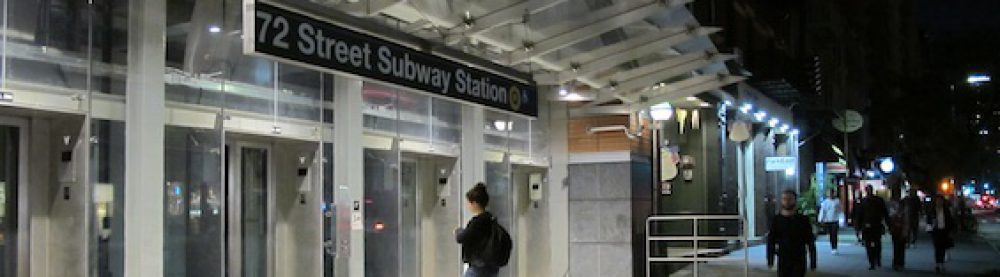
As it turns out, residents of the far East 70s or 80s will continue to be under-served by train service, even if the Second Avenue Subway is ever completed. There is no stop between the 86th Street and 72nd Street stations. Michael Horodniceanu, Nagaraja’s successor, told me during neighborhood tour of the underground construction this is intended to speed travel on the line. I had suspected that plans to construct a station in the high 70s were dropped because a developer pal of former MTA chairman Peter Kalikow was building a new high-rise on the spot, but clearly I was wrong.

Although Second Avenue Stubway, when it opens, will not shave much time from the commute of those living on East 79th Street and First Avenue or York, a more efficient and cost-effective service for them and everyone else is on the way.

The East River, the greatest transit artery in New York City, is one that few travel today, but the New York City Economic Development Corp. recently proposed five new ferry routes that would exploit its possibilities. Such service would connect waterfront neighborhoods in Queens, Brooklyn, Staten Island and the Bronx to Manhattan and to each other. It would also improve transit from midtown to the Lower East Side and Wall Street.

Current ferry service on the East River has proven to be a success. It served 1.2 million total riders last year, some 3,200 riders daily. Fare is $4.00 each way, and like the rest of public transit, it is subsidized. The city pays $2.22 or 55 percent, for each one-way trip, compared to 62 cents, or 35 percent, for the subway, which because of the varying fare structures averages $1.73 per trip. Increased use of ferries would make the water system more cost-effective.

Currently there is a pier at 34th Street on Manhattan’s East Side and shuttered one near Gracie Mansion at East 90th Street. An additional one in the mid-70s has been on the drawing board. Happily, construction of ferries would also cost taxpayers far less than the subway. A NYCETD report notes that the extension of the 7 train cost $1.6 billion per mile served, compared to the cost of construction of infrastructure serving the East River Ferry at $8 million per mile served. Unlike busses, ferries don’t travel on congested roads and bridges. Based on what figures I can glean from MTA reports and a helpful 2010 post on the 2nd Ave. Sagas blog, I calculate that construction of the Second Avenue subway ballooned to a cost of  $2.75 billion per mile.

Phase 1 of the Second Avenue Subway will end at Lexington Avenue and 63rd Street and is supposed to be operational by December, 2016 after much delay. Increased ferry routes, and the relatively new Select Busses on First and Second Avenue that have improved surface transit, should mean that other Manhattan neighborhoods will not be needlessly and pointlessly blighted at enormous cost to taxpayers.

Federal Decision Lends Hope to The Ramarley Graham Case

Police officer Richard Haste, who gunned down unarmed Ramarley Graham by his grandmother’s toilet in the Bronx nearly two years ago, may yet be indicted. U.S. District Court Judge P. Kevin Castel cleared the federal civil suit against him to proceed. Former Police Commissioner Ray Kelly and the New York Police Department are also named as defendants.

On Feb. 2, 2012, Haste and his partner pursued Martin from the street because they thought he was acting suspiciously. Without calling for back-up, the officers charged after him and onto private property without a search warrant. When the three stood before the toilet, Haste’s partner called out that the kid has a gun, so the Haste shot him down. Oops! Look, in fairness the police were onto something — frightened Graham was  flushing away marijuana when he died– maybe a plastic bag in his shaking hand gleamed like a gun.

This case deserves far more media attention than it has received, particularly by the major print media. However, the fact that this horrific incident has been so under-reported makes it more likely that many in New York have no opinion about the incident and could sit on a jury. The death of this young man is as worthy of nation attention and prolonged discussion as the Trayvon Martin case in Florida in which a black youth was killed by a neighborhood watch coordinator. [Enter “Ramarley Graham” on this blog’s search box to find two previous presentinthecity posts on the death]

A brief history of the policeman’s days in court thus far: Officer Haste pled not guilty to first and second degree manslaughter charges in June, 2012. In May 2013, the case was dismissed on a technicality when State Supreme Court Judge Steven Barrett ruled that the prosecution had not given proper instructions to a grand jury. Last August, a second grand jury decided not to indict, which led Graham’s family to ask the federal government to intervene. In a pending review, the U.S. Attorney’s office is considering whether Graham’s civil rights were violated.

As Jeff Mays of DNA Info reports in detail, Paulet Minzie, the owner of the building where Graham lived, has also filed suit against the police. She alleges that Haste and other officers terrorized and humiliated her and her family members when they banged on her door to gain admittance. Minzie says that she jumped out of the shower and grabbed a towel when she heard the pounding on her door. In the terror of the moment she says  she exposed herself to the officers and in fear urinated on herself.

In a full story on the latest developments, Khouri A. Atkinson of The Amsterdam News reports that Judge Castel asked the parties to consider whether they want the case decided by a mediator. They have until Jan. 14 to decide. The next court hearing for both lawsuits—filed by Graham’s family and Minzie—is Aug. 1.

I hope there will be a full trial with a detailed record. I want to know how Haste and his partner were trained — how did they come to be on our streets with loaded weapons making judgement calls? It is proper that Kelly is a defendant, because police are unlikely to be better, or even worse, than police policies.

I want to know Haste’s background — was he born and raised in New York City or is he a suburbanite come here to give multi-cultured city people what for? Am I far off the mark when the suburbanite police force, roaming this city where they can’t afford to live, make me think of Hessian soldiers hired by the British around 1776 to subdue unruly colonists? I honor the fact that the police are first responders — even though former Mayor Bloomberg did tell an audience at MIT that the police were his own army. Let us hope that the federal courts will help us sort this out.

Turning Off the Trickle Down Spigot

These are the peak days for Mayor Bill de Blasio, who took office a day ago and has not disappointed New Yorkers yet. This high point provides an opportunity to reflect on his greatest achievement. No, it’s not that 33 years after the inauguration of Pres. Ronald Reagan, the notion of trickle-down economics has finally trickled out, or that Progressives are emerging from cover, or even that the media sniffs the change in the wind.

The astonishing thing is that de Blasio trusted middle class voters to finally recognize their economic interests. Candidate de Blasio’s stated platform was about standing up for the poor, but the middle class did not feel threatened or excluded. Assisting have-nots (and de-segregating the South) is how the Democrats lost their unassailed majority and they have been scrambling ever since. This time, however, in 2013 New York City, the middle class rallied to support a man whose name they barely knew a year ago because he proclaimed a fundamental truth they recognized: Giuliani-Bloomberg New York was fast becoming Dickens London, a place where only an unrepentant Scrooge could feel secure. This is the New York they have come to know. They are now in as much or more jeopardy than people in public housing.

With 46 percent of New Yorkers at or near poverty after the supposed recovery from the Great Recession, those in the middle have seen proof that they are one job loss, or one serious health crisis, from near-poverty and possible homelessness. Ask a 45 year old who has been out of work for seven months how he or she envisions the future. Most know at least one such person, and having a talk with them is painful indeed.

In contrast, those earning more than $500,000 a year tend to feel threatened when they hear about resources going to the less fortunate. The proof is that de Blasio’s opponent Joseph Lhota prevailed in the wealthiest zip codes, those where average income exceeded $140,000.*

The new mayor hasn’t given up on the wealthy yet — in his inaugural address, de Blasio pointed out that the tax he proposes to levy on them to fund universal pre-kindergarten enrollment would only cost them about three dollars a day. He cajoled that this was the price of a latte.  He got a laugh, possibly because such a tariff would cost the rich too little to drive them down to middle class level – unless $500,000 in adjusted gross income is what it takes nowadays to be middle class in today’s New York. This is a point that many do ponder. And a latte is the first thing to go.

The mega-rich have been silent about de Blasio since his blow-out win. The Catholic ones feel on safer ground denouncing the Pope. Billionaire Ken Langone, founder of Home Depot, told Cardinal Timothy Dolan that when Pope Francis warned  “Money must serve, not rule,” the rich were offended. One donor was so miffed that he threatened to retaliate by withholding a seven-figure donation to St. Patrick’s Cathedral. Langone felt secure enough to offer this sentiment to CNBC.

This is the kind of billionaire mind-set that made middle class New York voters think.

*Click “average income” link in the lower right corner of the link for vote by personal wealth

Bloomberg Packs Heat, Obscures Light

On January 1, 2014 Michael Bloomberg will no longer be mayor of New York City, but he will continue to pick at the threads of the nation’s social safety net in indirect and almost untraceable ways.

The question is whether Bloomberg does it deliberately or not. Clearly he is working against elected Democrats in red states and thereby he assists Republicans who are not friendly to Social Security, Medicare, Medicaid, unemployment benefits or gun regulation.

In 2006 Bloomberg co-founded Mayors Against Illegal Guns with Boston Mayor Thomas Menino and became its largest funder. Its admirable mission is to promote public safety by cracking down on illegal firearms. Spurred by horrific homicides in the intervening years, the group has grown from an initial 15 to one thousand mayors in 46 states, including four in Arkansas, a state that increasingly leans toward Republicans.

Trouble began when, with Bloomberg-like gusto, this group took shotgun aim at those who did not rally to their dictates. These included moderate politicians in red states who declined to support unpopular legislation to restrict gun ownership, including background checks. This story unfolded around the nation throughout 2013, but the N.Y. Times just reported that Bloomberg’s aides were warned that they are endangering Democrats’ political chances. If Democrats lose, Republicans win, and their platform is not friendly to gun restrictions.

Former President Bill Clinton phoned Howard Wolfson, Bloomberg’s Deputy Mayor for Government Affairs and Communications, to request that the Bloomberg group drop its ads against Arkansas Sen. Mark Pryor, a beleaguered Democrat facing re-election in Clinton’s native state. Request denied. The ads ran. Pryor may have scored points with his constituents with his retort that he did not take orders from Bloomberg or New York City. We will find out next November when Arkansans either let him keep his Senate seat or award it to a Republican. I am betting that Pryor’s opponent won’t back gun restrictions either. Does Bloomberg think that far? He would if he truly cared about this issue or if he cared enough to hire people who could think effectively. Is Bloomberg aiming for gun restrictions or for a Republican majority? No one should count on his being a straight shooter, even with a $31 billion fortune in ammo. The people of New York City and the nation are not rid of him by a long shot.

Let There Be Peace on Earth — Decriminalize Pot Now

White people of all ages have long been able to use marijuana legally, at least if they were careful. Outgoing mayor Michael Bloomberg regrets that he quipped that he had enjoyed pot, yet his frank flippancy did offer a beacon of truth about enforcement of anti-drug laws. White people, even before they become billionaires, usually get off fairly easily for drug use, if they are detained at all. Cases in point are celebrities and their offspring. Google Lindsay Lohan and Cameron Douglas, who got into serious trouble only after their flouting of laws became too egregious and too well documented to ignore.

If Ramarley Graham, whom police shot dead by his grandmother’s toilet early in 2012, had been Bloomberg’s white child, he would have known he had little to fear from New York City police, who probably would not have charged into his dwelling without a warrant and slaughtered him because, once they found themselves inside the house, they decided he was armed. Turns out, the reason the 18-year old fled was because he did have a small amount of marijuana, but no gun. In a note worthy of a Dickens novel, the officer who shot him was named Haste.  A Bronx grand jury declined to bring charges again the officers.

In this Yuletide season, there come a ray of hope that this will be less likely to happen in future. State Senator Liz Krueger (D-Manhattan) has introduced legislation to legalize, regulate, and tax marijuana under state law along lines similar to the state’s current system regulating alcohol. A spokesman for Gov. Andrew Cuomo declared her move a “non-starter”  but many legislators are working to see it pass. The fact that this is politically risky is clear enough to cut through any smoky haze, as is the fact that the war on drugs has been as constructive as the one Vietnam. Among the benefits of decriminalization are these: it would keep youth out of prison crime schools (this admittedly would not help upstate communities that depend upon prisoners from downstate); it would spare the lives of police who can be injured or slain in drug busts; it would preserve the characters of those corrupted by drug lords; and it would help taxpayers, if the $1.7 billion New York City pot industry were taxed. Recognizing the disaster of the drug war,  Uruguay just took a innovative step. Alarmed that drug-related murders accounted for a third of total homicides in 2012, its legislators passed a bill to legalize marijuana and put its production and sale under government control and President Jose Mujica will sign it, a brave move since two-thirds of Uruguayans say they oppose it.

Organized crime around the globe is surely hiring lobbyists to fight Kruger’s bill right now.

Sen. Chuck Schumer Is Harrassing Me

In the recent election season I was subjected to harassing telephone calls from Sen. Charles E. Schumer (D-NY). Before the Democratic primary, although I am on the Do Not Call Registry, Schumer robocalled me several times urging me to vote for his candidates — City Council Speaker Christine Quinn for Mayor and  State Senator Daniel Squadron for Public Advocate. His calls always came at inconvenient times when I was trying to eat a meal or balance on a stepladder. His endorsements were as ineffective as they were unwelcome. Both Squadron and Quinn lost their races decisively. In Brooklyn, however his candidate for District Attorney Kenneth Thompson prevailed. Schumer may be running out of juice in more ways than one — in previous election cycles he robodialed me many more times than he did this year.

So imagine my surprise when I learned that Schumer has proposed legislation to raise fines and increase punishments on telemarketers violating Do Not Call rules. Has he no self-knowledge whatsoever? Of course not. Does he not know he violates the spirit if not the letter of these laws himself? Obviously not. How could it be? Self-centered self-importance provides the thick hide that pols are always telling us they must have. Of course, Schumer is not the only pol to robocall. He has just made himself the most ridiculous.

The legislation that needs to be proposed is the expansion of the Do Not Call Registry to  include charities, political organizations, and telephone surveyors as well as debt collectors. In enacting the law, legislators gave the Do Not Call Registry no sway over these groups, which serve the politicians themselves. Chief among them are telephone surveyors, whose calls harass us as surely as robocall scam artists. They take the surveys that enable elected officials and wannabes to figure out which way the wind blows so that they can amend positions on public issues.

The Senator says the number of unwanted telemarketing calls has skyrocketed. His press release notes, “As of August 2013, the FTC was logging 140,000 to 200,000 robocall complaints monthly compared to 65,000 in October 2010, according to published reports.”

He is right about that, and I support whatever curtails telemarketers. Unfortunately, relevant laws now on the books allow Sen. Schumer and his ilk to call us whenever they wish and as often as they want. I would like to opt out of these as well. If politicians and non-profits believe their messages are important, let them use the mails, which they already do anyway. That way they would help the U.S. Postal Service (but admittedly add to junk mail to be recycled). They could also continue to spam us via Internet, which generates no paper waste. Meanwhile, I challenge Sen. Schumer to figure out the number of unwanted robocalls he is generating and stop generating them. It is for his own good too — the electorate is less likely to know that he supports candidates they don’t.

Biking with de Blasio – End the Cold War Against Pedestrians

The other evening a 40ish delivery man artfully rode his bicycle between another woman and myself who were walking on a Lexington Avenue sidewalk. The cyclist frightened us both but did not physically injure us. He was breaking the law that forbids anyone over the age of 14 from riding on the sidewalks, but no matter. The police were elsewhere — frisking doctors, lawyers, job-seekers and others who are guilty of having too much pigment in poorer neighborhoods. Even if the police department decided to make its presence visible in “safe” neighborhoods, police don’t enforce N.Y. ADC. LAW 19-176. Through the years on those rare occasions when I have seen uniformed policemen walking through Manhattan’s East Side, I have seen adult cyclists weave around them. The police have never broken stride.

Terrorizing pedestrians in New York City is not regarded as serious if the person doing the terrorizing is on a bicycle and does not seem to be an Arab. It doesn’t seem to matter much that cyclists cause serious injury to pedestrians. Each year more than 500 NYC residents are injured badly enough to be treated in area hospitals, according to data collected between 2007 and 2010.

The Stuart C. Gruskin Family Foundation is working on this, partly because Stuart C. Gruskin was slain in an incident involving a cyclist riding the wrong way up a Midtown street. (Could this indicate that cyclists disobeying laws are a threat to public safety?) The foundation works to promote safety for cyclists and pedestrians and as well. In fact all of us, whether we are walking, riding a bicycle or operating a motor vehicle are supposed to obey the law. The cyclists have defeated me: I now stop on red. When I have the right of way I for one feel safer in the path of an approaching truck than I do in the path of a bicycle. Opinions can differ, but I have learned that the trucker will at least try to stop.

So here’s how we get to Bill de Blasio, who happily is New York City’s incumbent Mayor and who has promised to look out for people who have felt ignored for the last dozen years or so. He has said that if elected he would expand bike lanes and the bike sharing CitiBike program, with a goal of raising the percentage of city trips taken by bike to 6 percent by 2020. Fine, but he has another shoe to drop before it is knocked off by a speeding cyclist.  In addition, Mayor de Blasio, working with the City Council, needs to insure that all cyclists are subject to laws that govern commercial cyclists and he needs to insist that those laws are enforced.  He also must see that even non-commercial cyclists are licensed.

Cyclists should be required to wear  “a jacket, vest, or other wearing apparel” with a number printed in large type by which they can be identified. This number needs to link to CitiBike or to city records. If Citibank marketers have to create jobs and hire New Yorkers to issue licenses at their blue racks, so be it. Most cyclists already wear helmets, so let them sport license numbers as well. Motor vehicle drivers and dog owners need to buy licenses – why shouldn’t cyclists? Why does a toy poodle need to wear identification and not a human racing through red lights and over sidewalks? Such identification would help to apprehend those who do not properly follow city laws and it might even remind cyclists that they have responsibilities to others as well as to themselves. They seem to believe they are saving the planet…how about sparing pedestrians as well?

Outgoing Bloomberg Transportation Commissioner Janette Sadik-Khan, known to some as Bicycle Woman, spent tax dollars on education programs for cyclists – although you would think everyone everywhere knows that a red stop light or sign means stop and that enforcement of laws might have been the way to go. The next Transportation Commissioner, or whoever is supposed to be in charge, needs to put energy into making the privileged class that is cyclists responsible citizens as well. There is more to being responsible than donning a helmet for one’s own protection. No mention of bike lanes was made in this post — they have been good for CitiBike and Citibank, but I don’t see how they have helped pedestrians who use fewer public resources than cyclists when they are allowed to walk in safety.