Confessions of A Poll Worker

I volunteered to work the polls to improve voting in New York City. Instead I became part of the challenge. If you meet me Nov. 5 I will do my best, but now we are using optical-scanning machines. I have not so much as seen one since I was trained on August 19 when 12 hours of training were crammed into six because we had to learn the scanner as well as the lever machine for the primary. My section never discussed write-in voting, but no matter. That wasn’t on the test.
Don’t despair. Assisting the first few voters on Election Day might enable me to get the hang of it, and I may have the guidance of a more experienced poll worker. I myself voted on a scanner last year when the confusion at my polling place during the presidential election inspired me to volunteer with the Board of Elections so I can help you this year.
You might remember me from the primary election, if you are one of the 22 percent of registered Democrats and 13 percent of registered Republicans who bothered to vote. Less likely, you encountered me at the Public Advocate run-off when only 6.7 percent of registered Democrats appeared. On that day to break the afternoon lull we poll workers broke into spontaneous applause when voters showed up. They must have known they were special because when they departed, they waved good-by in the grand manner of the British royal family.
Do you wonder what motivates us poll workers? Some believe in civic duty. Most are in it for the pay, which works out to about $13 an hour for a sixteen-hour day with two hours of breaks that are not always honored. We start at 5 a.m., sometimes far from home. One colleague, a social worker, told me that he volunteered after receiving a notice to tell his clients to sign up to be poll workers and earn extra cash.
Meanwhile, here’s a peek at a few things we’d rather you did not know: on primary day, one of the two coordinators at my election site whom we will call Susie told us to forget what we had learned in training. She observed that everything we were doing was irrelevant because “things are being decided at a very high level.” Whether her problem was corruption or medication levels, I will never know. However, detecting certain mood swings and her lack of interest my colleagues and I turned to the other coordinator, whom we’ll call Mary, who had conducted trainings and insisted on doing everything “by the book.” When the polls closed, Mary announced that as a result of working with Susie, she would never work the polls again. She may have meant it because when we returned a few weeks later for the runoff for Public Advocate, Susie was the only coordinator on site and she managed alone.
Also, the closing of the polls, when tallies and back-ups are recorded, gets a bit slapdash because we are all eager to leave. On primary night I ended up as chairman of my election district because no one else wanted to sign the time sheets and tallies. After hurried hubbub or retrieving forms, I signed and sealed support materials and gave them to a police officer who signed a receipt. But then Susie discovered I had left out something important. No matter. I snatched the package away from the surprised officer, peeled off the seals, inserted the missing item, and sealed it up again. Work done! A few weeks later on the night of the runoff Susie hurried me even more, herself pressured by the menacing woman collecting our blunt-end scissors who was ready to go.
If you don’t like our methods, you could demand that the New York City Board of Elections do a better job of training and recruitment, possibly calling for volunteers at places of worship, libraries and through public service announcements. Possibly outreach should be less about a payday for good people who need money and more about voting. However, what matters most is better training and improved management. You could write officials to demand a more organized process and back that up by actually turning out to vote yourself.
I swear it does matter. When I was a teenager in the segregated South people died fighting to claim the right to vote. Partly because of them, I saw candidates elected throughout the country who expanded possibilities for millions of Americans and for the mandate for peace. Then officials were elected who put the brake on those expansions. So that’s why I get a little serious about voting. Often I don’t like the candidates, so I write one in, which reminds me to check my manual to learn how you can do that too.

But whatever happens, I don’t think you have to worry about the accuracy of the vote unless it’s really close. Poll watchers from both parties and from all candidates check on us through the day and each writes down the final count at night. Checks and balances for an accurate count are in place, but they are above my level, which is not the level where I deal with you.

The Grim Reaper Is Watching You

I was reading news on my computer when the image of a charming little building caught my eye. Clicking on the irresistible piece of architecture in the corner of my screen led to a true experience of what targets we have all become and why the Internet is “free.” It made me wonder if the National Security Agency could think I am dying. Here’s what happened:

When the weather turned pleasant I decided to make a pilgrimage to Woodlawn Cemetery and the graves of Herman Melville and Nellie Bly. Having visited Père-Lachaise, Novodevichy, Forest Lawn, and Greenwood in Brooklyn, I expected Internet searches to produce tourist-friendly information about public transportation, the visitors’ entrance gate (Jerome Avenue or Webster Avenue?) and a map of notable resting places. Since I would lead a friend through the 400 acres of this National Historic Landmark in the Bronx, and I had the energy for only a few relevant ones, I kept going back to the website, checking the directions, and studying the MTA trip planner. I googled Woodlawn Cemetery many times.

At the last minute, I went alone to the Bronx. While I did not have a map, I did have one particular experience – the sight of a miniature Parthenon set in the middle of an oval of velvet green lawn maybe 60 feet in diameter. It was the resting place of none other than Jay Gould. I was brooding over his robber baron ways, his capture of 19th century railroads and corner of the gold market, when I stumbled badly. I found that my foot was buried in a rare hole on that smooth expanse of lawn. I limped away, a wounded sophisticate unwilling to believe that the wily Gould had reached out to a disapproving mortal.

Hole is obscured to the far right

Hole is obscured to the far right

Woodlawn Cemetery fascinated me and inspired more research into various mausoleums and their contents and architects while I iced my ankle back at home.

Soon thereafter the charming image appeared in the corner of my computer screen. My click detonated it into an ad exhorting me to “Prepare for Eternity.” The charming dwelling, a cross between a folly and an arboreous weekend retreat, was in fact a little house of death. For weeks a mausoleum border appeared on every site I visited. It was on the New York Times, the Guardian, the Telegraph. Whatever site I visited, I was greeted by the same call to “Prepare for Eternity.” Swimoutlet.com had been insistent too, but I had bought their goggles. Turns out that mausoleums are products too. One even erupted into my face on a pop-up ad.

I can live with mortality, but I don’t like being stalked. Death haunts us all, but algorithms hunt us down. Research “Woodlawn Cemetery” and “mauseolum” fifteen times in three days and see what happens. You’ll be preparing for something too.

Don’t Shush the Libraries!

I don’t know whether the New York Library — its wonderful buildings or the system itself –can be saved from its Board of Trustees and the administrators that serve it, but I do believe that everyone who has promoted or rubber-stamped the destruction of the library and the privatization of public property into private hands — all on the cheap — will be exposed. In the meantime, please read and follow Noticing New York and Citizens Defending Libraries. These blogs should be read, evaluated and acted upon. Our libraries are being turned into event spaces for galas and privatized on the cheap. Those of us who need them and who support them with our tax dollars are being robbed. Remember the Donnell!

Democratization in Action at the New York Public Library

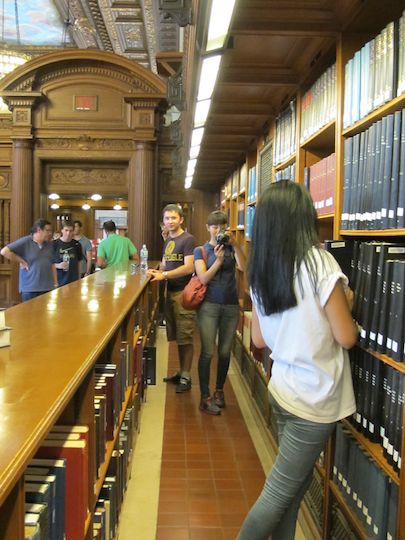
I brought my camera to the New York Public Library to take pictures of tourists taking pictures of me. They seemed annoyed about it. Maybe I distracted them from shooting door jambs, windows, and people who were actually using books – books that arrive as many as five days after we request them. Welcome to the Rose Main Reading Room of the Stephen A. Schwarzman Building, once better known as The New York Public Library at Fifth Avenue and 42nd Street.

Good thing no patron needed these books

Good thing no patron needed these books

Library trustees and administrators have proposed a controversial $300 million-and-counting renovation involving starchitect Norman Foster, and the proposed sale of two major branches at prices attractive to developers, in part to “democratize” the library. One can infer that they want to rescue the library from overuse by those elitists known as Researchers who have hogged the place for years for their own narrow purposes. The library board and trustees might disdain academic scholarship, but they should know that Researchers using the New York Public Library include DeWitt Wallace who co-founded The Reader’s Digest; Robert Caro whose magisterial biographies of Robert Moses and Lyndon Johnson have corralled multiple prizes and illuminated significant aspects of our history; and Betty Friedan, author of the world-rocking Feminine Mystique.
Although there are rooms dedicated for researchers who qualify for them, through its century of history, scholars and the public have used the library side by side, not as a carnival boardwalk but as a place to learn and grow. Alfred Kazin wrote in New York Jew of tracing the development of American literature as he delighted in the Americans he found there: “Street philosophers, fanatics, advertising agents, the homeless – passing faces in the crowd. I liked reading and working out my ideas in the minds of that endless crowd walking in an out of [Room] 315 looking for something – that Depression crowd so pent up, searching for puzzle contests, beauty contests, clues to buried treasure off Sandy Hook…” Kazin felt himself “entangled” in their hunger and was glad of it.
As I read Kazin’s words in the North Hall, that half of the Reading Room that is designated a “quiet zone,” two howling children surged past crowded tables of readers. Their mother caught up to them at the door of the Rare Book and Manuscript and Archives Division at the far end of the room and hauled them back past us all the while continuing to drown us in a river of noise. The harried guard who finally caught up to her was clear: “You brought them into the wrong room.” So she carried them into the South Hall of the Reading Room that is not a Quiet Zone where their sounds proceeded to build.
Is the success or value of a hospital measure by how many patients have visitors and how many screaming children fill their cafeterias? Would it help the trustees and administrators, who clearly don’t use the library, to know that the library is sufficiently democratized so that it is hard to find a seat in the Reading Room if one arrives after noon Monday through Saturday or after the Library opens Sunday at 1 p.m.?
Meanwhile, tables and chairs are virtually unused in The Edna Barnes Solomon Room on the third floor, formerly for special exhibitions. It has been repurposed for wi-fi, with no book deliveries allowed. What a pity that this near empty cavern, which the library rents it out for parties, could not have been used for the Asian, Middle Eastern and/or Slavic divisions that have been closed. Many other less specialized research collection books have been moved off-site to New Jersey and the Bronx, which is why it takes several days to get a book. One might not complain if archaic texts on obscure topics (the kind undemocratic Researchers would want) had been exiled, but books in demand are out of ready reach as well. “Childhood and Society,” Erik H. Ericson’s classic study that won the Pulitzer Prize and the National Book Award, and has been seminal to Researchers (those creeps!) seeking to foster human development and to thousands of college students through the years, is kept off-site. After I requested it from my home computer, it took three days to arrive at the Reading Room. I read my long-awaited book as far as page 219 when I discovered that the next 18 pages had been cut out. The librarian I brought it to advised me to buy a copy at The Strand Bookstore “for very little money,” because he solemnly said, “This library is not about books anymore.”
Another librarian checked the computer to learn that two other off-site copies of “Childhood and Society” were also in use, one at the Science Industry Business Library, which library trustees seek to sell off at an attractive price to a developer, and the other at the Schomburg Center in Harlem. I had waited longer than I intended and I needed to finish that book by nightfall, so I used more of the day travelling. “Childhood and Society” was sold out at the Strand, where I hoped to find a discounted used copy, so I went to Barnes & Noble where for $18.95 plus tax I bought a copy of the book that my tax dollars had purchased for the public library patrons. Even as an author myself with my own books to sell, I want New York library patrons to be able to use the books that their tax dollars pay for. However, Mr. Schwarzman, chairman and CEO of the Blackstone Group, a private equity and financial advisory firm, a man whose name is on the building, might approve that I had been forced to spend my Researcher finances instead of using up his library. Could it be that someone could consider a member of the public who uses public resources a deadbeat? Maybe that is the whole mindset behind “democratization” of a library that was once maintained as a resource to be used by the people and not just photographed by them as it turns from a temple of democracy into event space.

Here’s A Clue About Future Jobs in NYC For Politicians Who Wish To See Them

The city’s mayoral candidates are talking about job creation and rethinking workforce development programs, as well they should. The Stack, a new apartment building on Broadway and 204th Street in Manhattan, was largely pre-fabricated — meaning that it was built in a factory. That is a promising in a city where on-site construction in tight spaces, often under difficult weather conditions, is expensive and has adverse effects on surrounding blocks. After reading about The Stack last month on the  NY1 website I queried the broadcaster about where the factory was located. An executive was kind enough to reply that the factory was in Pennsylvania, but said via e-mail that he did not see why that mattered. Here’s why the location matters: We need jobs in New York!

Learning that the building wasn’t made in China or Canada but in the U.S.A. was a relief, but here’s the point: if this is the future of construction, Gov. Andrew Cuomo and the city’s next mayor and its construction trades and unions need to be planning pre-fab construction in New York State and in the city — how about the Brooklyn Navy Yards and/or manufacturing areas that Bloomberg is turning residential? How about upstate? Here is a potential source of real jobs, hopefully ones that can support families and offer health care and advancement. Politicians we elect should not allow our jobs to be sent out of the city, much less out of the state and New Yorkers need to find ways to make sure that they don’t.

Why Things Have Gotten Quiet In NYC

Wealthy New Yorkers have managed to shut down debate about what is good for New York City, including the vanishing middle class and those who believe in zoning laws. A N.Y. Times story today about opposition to Mayor Bloomberg’s outsize development plan for area around Grand Central Station points out that disgust with the plan for midtown east has helped to revive the formerly moribund City Club of New York. It reports that club secretary Stuart Pertz, an architect who was on the City Planning Commission in the 1980s, says that organizations are stymied by their need for donations and they fear offending executives, or working against their interests, when they need them to provide funding.

The Bloomberg Administration is finally drawing to a close, four years later than we expected it to by law, but puppeteer Bloomberg will still have his billions, so look for this situation to continue. The Koch Brothers and those hedge fund managers who do not receive crippling fines from the government, all hold sway on important boards. At this point non-profits that are afraid to pursue their missions, or decided to pursue agendas at half-throttle as many do, should disband for all our sakes, or, as in the case of the once influential City Club of New York, get loud.

Remember How NYC Democrats Used to Sound?

“We’ve gotten comfortable seeing low-wage workers as sharecroppers. When was the last time the mayor blew a blood vessel about the systematic violation of wage protections?” That question comes from Harvey Robins, who held top positions in the Koch and Dinkins Administrations, as quoted in Michael Powell’s column this morning in the N.Y. Times. Robins would like to see insurance companies subject to the business tax and would end the $17 million property tax abasement for Madison Square Garden. Robins, who served as deputy schools chancellor in the Koch Administration and ran Dinkins’ Office of Operations, is so revolutionary that he asks why Chicago and Boston keep their libraries open 50 hours a week while NYC barely muster five days.
I would like to know who Robins is endorsing in the mayor’s race. Better yet, I want to hear lots more from him.

Link

Sallie Mae exports U.S. jobs to Asia, Where It Overcharges Our Military

Today brings the news that Sallie Mae may be bilking our military — the Federal Deposit Insurance Corp. will accuse the student lending firm of charging more than the 6 percent it is allowed, according to the N.Y. Times story.

But Sallie Mae has long been a bad citizen. For at least a decade, as U.S students and their parents labor under a high debt load (much of it to Sallie Mae) and suffer from a high unemployment rate, Sallie Mae has exported jobs to Asia. A decade ago it employed Indians as customer service representatives, now they is more likely to be Filipinos. Why not employ Americans who labor to pay off Sallie Mae? I think even organized crime understands the logic of this. Return Sallie Mae jobs to the U.S. and give them to young people and their parents. Hapless Americans are plagued by high unemployment, and are burdened by long-term debt to Sallie Mae. Western New York State would be an excellent place to set up call service centers.

I know about the reps because I was foolish enough to take out a Sallie Mae loan a dozen years ago to help finance graduate school. I have been dealing with their reps, many of them impossible to understand, especially when the discussion is about numbers, for years. I have written about this to New York Sen. Charles Schumer and Kristen Gillibrand, as well as to Sallie Mae CEO and president John F. Remondi. No response from any of them, although I first contacted the senators months ago. A garbled boiler plate response saying your-concerns-are-my-concerns from Schumer’s people might have been his reply. Impossible to tell. I recently sent a letter to Sen. Elizabeth Warren of Massachusetts who may be less beholden to Wall Street lobbyists. It’s time U.S. citizens received value from our debt. Cheap labor from Chad and Chloe in the Philippines is not helping Americans or its economy which has been sacrificed for multi-national corporations who own the ears and conscience of our politicians.

Bad Boys Are Looking Good

If this is how elite newspaper editors and the police behave, no wonder miscreants are looking good. As shocking as the news that the Bronx grand jury failed to indict the policeman who gunned down Ramarley Graham by his grandmother’s toilet is the way the New York Times treated the story.

This morning it ran yet another “blacks love bad boys Spitzer and Weiner” story on the front page of its printed edition, while placing the Bronx-cop-goes-free-for-killing-unarmed-black-youth on way back on page 13.

The Times had an index note at the bottom of its page one “Police Killing Won’t Go To Trial” but that seemed a little obscure. In contrast, the old news was prominent — the Times also ran stories about African American support for law-bending candidates on July 15, July 20 and July 29, so it was hard to find the news there.

I sent this comment to the NY Times this morning, but they did not publish it. I also emailed my concerns to its Public Editor. The vile treatment of the late Ramarley Graham by the NY Times, a paper that I rely on, is the inspiration for this blog. Horrible things are happening in New York City today, and it is not ordinary citizens who perpetrate them nor can street criminals equal the harm done by our failed elites. Bull Connor and Boss Tweed come to my mind every day.